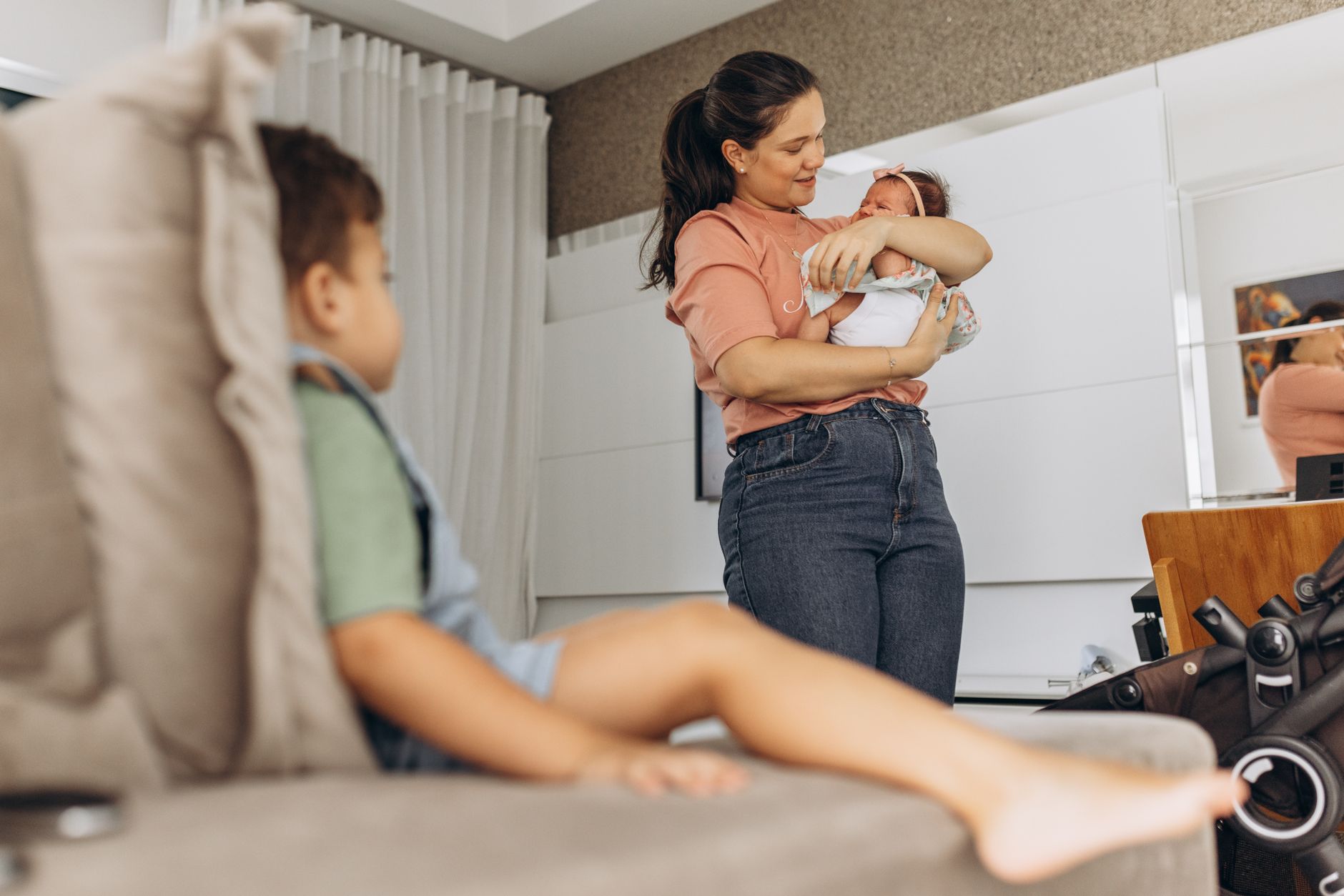
You’ve heard the advice: “Toddlers don’t understand jealousy.” But the truth is, they do understand—just not in the way adults do. Their world is simple: “You are mine.” When a new baby arrives, that world gets complicated. Here’s why the acting out starts:
1. Routine disruption
Toddlers thrive on predictability. If bedtime used to be a cuddly story followed by a lullaby, but now it’s a rushed goodnight kiss because the baby is crying, that’s a big deal. Even small changes—like skipping a favorite snack or having to share your lap—can feel like betrayal. How to ease your toddler’s jealousy when bringing baby home offers practical tips for smoothing transitions.
Consider this: Your toddler’s brain is like a well-oiled machine running on routine. When that machine gets reprogrammed overnight, it’s not their fault they’re confused. The National Institute of Child Health and Human Development notes that toddlers often experience “developmental regression” during major life transitions, as their brains temporarily revert to earlier coping mechanisms.
2. Attention shift
Newborns are needy. They cry. They demand feeding. They need swaddling. And while you’re loving on the baby, your toddler might feel invisible. Their brain isn’t sophisticated enough to understand that you can also love them—only that you’re choosing the baby right now. This isn’t about the baby being better; it’s about the toddler’s fear of being forgotten.
3. Hormonal and emotional changes in you
Postpartum hormones can make parents more emotionally reactive, and toddlers pick up on that. If you’re snappish or distracted, your toddler may interpret that as “I don’t want you anymore.” Even if you’re not intentionally ignoring them, their brain might register it as rejection. The American Psychological Association highlights how toddlers are highly attuned to parental emotional states, often mirroring stress or anxiety.
4. Developmental milestones colliding
Many toddlers hit big developmental leaps—like learning to walk, talk, or potty train—around the time a new baby arrives. If they’re already struggling with a new skill, the added stress of a sibling can make them feel even more overwhelmed. For example, a toddler who’s just started saying “no” might suddenly throw tantrums over everything because they’re processing their own autonomy while also dealing with the baby’s needs.
5. Sensory overload
Newborns are loud, smell different, and move unpredictably. For a toddler who’s used to a quiet, predictable world, this sensory bombardment can be overwhelming. Some toddlers react by withdrawing entirely, while others become hyperactive or clingy. If your toddler seems constantly on edge or seems to “zone out,” they might be trying to cope with sensory fatigue. The American Speech-Language-Hearing Association suggests that toddlers with sensory sensitivities may experience heightened jealousy during transitions like this.
---
How to prepare a toddler for a new sibling to minimize jealousy
Preparation is key—especially when it comes to toddler jealousy. The goal isn’t to shield them from change (that’s impossible) but to help them feel included rather than left out. Here’s how to set them up for success:
Start early (even before birth)
- Read books about siblings. Books like The New Baby by Karen Katz or Love You Forever by Robert Munsch normalize the feelings of a toddler adjusting to a new baby. Many parents report that reading these books before the baby arrives helps their toddler feel more prepared.
- Involve them in baby prep. Let them pick out a onesie for the baby, help decorate the nursery, or even “help” pack the hospital bag (with supervision). This builds a sense of ownership and excitement.
- Talk about the baby often. Use simple language: “The baby is coming to live with us, and we’re going to love them so much.” Avoid vague phrases like “we’re having a baby” that don’t connect to their reality.
- Use a doll or stuffed animal to practice sibling interactions. Role-play scenarios like “helping the baby” or “giving the baby a hug” to normalize the idea of sharing your attention.
Create a “big sibling” role
Toddlers love feeling important. Give them a job! This could be as simple as:
- “You’re the baby’s first teacher—show them how to clap!”
- “You can be the one to sing to the baby when they’re fussy.”
- “When the baby cries, you can give me a hug to tell me you’re okay.”
One mom we interviewed used a “big sibling journal” where her toddler could draw pictures of the baby and write (or dictate) what they loved about being a big sibling. This gave her a tangible way to contribute and feel proud. Another creative approach is to create a “big sibling certificate” that your toddler can hang in their room, celebrating their role in the family.
Avoid comparing them to the baby
Never say things like, “The baby can’t walk yet, but you could!” or “Look how cute the baby is—just like you were!” This only reinforces the idea that the baby is somehow “better” or more loved. Instead, focus on their strengths: “You’re such a good helper!” or “You’re the best big sister because you share your toys.”
---
Effective strategies to manage toddler jealousy of a newborn
Even with the best preparation, some jealousy will surface. The key is to respond with consistency and warmth. Here’s how to handle it:
1. Give one-on-one time daily
Schedule at least 15–20 minutes of undivided attention every day—whether it’s a special storytime, a trip to the park, or just sitting on the floor and playing with blocks. This reassures them that they’re still a priority. If you’re overwhelmed, even 10 minutes of focused eye contact while they eat breakfast can make a difference.
2. Use “feelings language”
When your toddler acts out, instead of saying “Stop that!” try:
“I see you’re really mad. It’s okay to feel that way. The baby is taking up a lot of your mommy’s time right now, isn’t it?”
This validates their emotions without enabling the behavior. If they’re clingy, acknowledge it:
“I know you miss our special time together. Let’s make a plan for tomorrow so you get some one-on-one love.”
3. Set clear boundaries
Toddlers test limits when they feel insecure. If they’re hitting the baby, calmly but firmly say, “Hands are for hugging, not hitting. Let’s try a gentle touch.” Redirect their energy:
“Would you like to help me fold the baby’s burp cloth?”
This gives them a constructive outlet for their frustration.
4. Praise their positive interactions
When your toddler kisses the baby, shares a toy, or helps hold a blanket, praise them immediately:
“Wow! You’re such a great big sister! The baby loves it when you smile at them.”
This reinforces the behavior you want to see more of.
5. Create a “special box”
Fill a small box with their favorite small toys, stickers, or a few special snacks. Keep it nearby so they can access it when they’re feeling left out. This gives them a sense of control and something tangible to comfort themselves with. You can also include a note that says, “This is your special box—it’s always here for you!”
---
Is toddler regression normal when a new baby comes home
Yes—absolutely. Regression is a normal part of adjusting to a new sibling. Think of it like a developmental reset. Your toddler might:
- Start wetting the bed again after months of dry nights.
- Revert to baby talk or call you “mama” instead of your name.
- Refuse to eat certain foods they used to love.
- Throw tantrums over minor inconveniences (e.g., not getting their favorite snack).
- Suddenly insist on sleeping in your bed again, even if they’ve been sleeping independently for months.
This isn’t a sign that you’re doing something wrong. It’s their brain’s way of saying, “I need you to help me figure this out.” The key is to stay patient and consistent. If you’ve been potty training, keep reinforcing good behavior—just be prepared for setbacks. If bedtime routines were working, stick to them as much as possible, even if it’s harder with a newborn in the house.
One reader shared that her toddler, who had been sleeping through the night, started waking up at 4 a.m. crying for her. She resisted the urge to give in and instead whispered, “I hear you. Mommy’s right here. Let’s try to sleep now.” Over time, the night wakings decreased as her toddler felt reassured. The American Academy of Sleep Medicine notes that toddlers may experience sleep disturbances during major life changes, as their sense of security is disrupted.
---
How to balance attention between toddler and newborn
Balancing attention feels like walking a tightrope—especially when the newborn’s needs are constant. The secret is intentionality. Here’s how to make it work:
1. Create a “special time” routine
Block out 15–30 minutes each day (even if it’s just after the baby’s nap) to give your toddler your full attention. This could be:
- A “big kid” activity (e.g., helping to set the table, picking out clothes for the baby).
- A quiet time together (reading, coloring, or just sitting on the couch).
- A “secret” snack or small treat (e.g., a special juice box or a favorite cracker).
- A “daddy/dad/mommy time”: If your partner is available, have them take over the toddler for a short period while you care for the baby. This can be a game-changer for both of you.
2. Use the “two-minute rule”
If your toddler asks for your attention while you’re caring for the baby, try the two-minute rule:
“I can’t talk right now, but I’ll be with you in two minutes. Let’s count down together!”
This gives them a sense of control and reassurance that you’ll return to them.
3. Involve the toddler in baby care (safely)
Toddlers love feeling helpful. Age-appropriate tasks include:
- Holding a blanket while you change the baby’s diaper.
- Gently patting the baby’s back (with supervision).
- Fetching a pacifier or a burp cloth.
- Using a baby doll to practice diaper changes or feeding. This can help them feel more confident and less anxious about the baby’s needs.
This builds their confidence and gives them a sense of contribution.
4. Schedule “me time” for yourself
When you’re running on empty, everyone suffers. Try to carve out even 10 minutes a day to recharge—whether it’s a quick walk, a cup of coffee, or just sitting quietly. If you’re exhausted, your toddler will feel your stress and act out more. How to ease your toddler’s jealousy when bringing baby home includes tips for self-care during this chaotic time.
---
How to help your toddler cope with the baby’s crying
Newborn crying can feel endless, and it’s one of the biggest triggers for toddler jealousy. The key is to help your toddler understand that crying is normal—and that they can still be involved in comforting the baby. Here’s how:
1. Explain the baby’s needs
Use simple, reassuring language:
“The baby is hungry, and that’s why they’re crying. Mommy will feed them, and then they’ll feel better.”
This helps your toddler see the crying as temporary and solvable. Avoid phrases like “the baby is a crybaby,” as this can make your toddler feel like the baby is “bad” or “difficult.”
2. Give them a “comforting” role
Let your toddler hold a pacifier, a soft blanket, or even pat the baby’s back (with supervision). You can say:
“You can be the one to hold the baby’s hand while I feed them. That’s a big job!”
This gives them a sense of control and purpose.
3. Use white noise or a sound machine
If your toddler is sensitive to the sound of crying, try using a white noise machine or a sound machine with lullabies. This can help soothe both the baby and your toddler. Some parents find that playing soft music or a podcast in the background helps create a calmer environment.
4. Create a “quiet time” for your toddler
If the baby’s crying is overwhelming, give your toddler a quiet activity—like coloring, listening to a story, or playing with a favorite toy—in another room. This can help them feel safe and secure while the baby is being soothed.
---
When to seek help for extreme toddler jealousy of new baby
Most toddler jealousy is normal and manageable with patience and consistency. But in rare cases, it may escalate into something more serious. Seek help if:
- Your toddler shows extreme aggression, like hitting, biting, or scratching the baby (or you) repeatedly, even after redirection.
- They refuse to interact with the baby at all, showing fear or hostility that doesn’t improve with time.
- Their behavior disrupts daily life, such as refusing to eat, sleep, or go to daycare.
- You notice signs of anxiety or depression, like prolonged sadness, withdrawal, or loss of interest in activities they once enjoyed.
- Their speech or social skills regress significantly, such as stopping words altogether or avoiding eye contact.
- They exhibit obsessive or ritualistic behaviors, like repeatedly asking the same question or insisting on the exact same routine, which disrupts your daily life.
If you’re concerned, talk to your pediatrician. They may refer you to a child psychologist or therapist who specializes in sibling dynamics. Early intervention can help your toddler adjust more smoothly. The American Academy of Child and Adolescent Psychiatry provides resources for parents concerned about their child’s emotional well-being during major life transitions.
---
Age-appropriate ways to involve a toddler with a new sibling
Involving your toddler in positive interactions with the baby helps them feel like a team member rather than a bystander. Here’s how to do it by age:
12–18 months
- Let them hold a soft blanket or pacifier while you change the baby’s diaper.
- Encourage gentle touching (e.g., patting the baby’s back or holding their hand).
- Read interactive books about babies together.
- Use a baby doll for pretend play, letting them “feed” or “change” the doll like they’ve seen you do with the baby.
18–24 months
- Give them a “big helper” job, like fetching a diaper or a burp cloth.
- Let them help with bath time (with supervision) by handing you a washcloth.
- Play pretend games where they’re the “doctor” checking on the baby.
- Let them “feed” the baby with a bottle (even if it’s just holding it while you pour the formula).
2–3 years
- Have them help pick out the baby’s clothes for the day.
- Let them sing or tell a story to the baby.
- Give them a special “big sibling” task, like putting the baby’s pacifier in their mouth.
- Create a “big sibling” photo album where they can add pictures of their interactions with the baby.
3–4 years
- Have them help with feeding (e.g., holding the bottle or spoon).
- Let them draw a picture for the baby and hang it in the nursery.
- Encourage them to read a book to the baby (even if it’s just pointing at pictures).
- Let them “teach” the baby simple words or songs they know.
---
Myth vs. Fact: Toddler Jealousy
Myth: “If my toddler is jealous, it means I’m not a good parent.”
Fact: Jealousy is a normal part of sibling dynamics. It doesn’t reflect your parenting—it’s a developmental phase. The goal isn’t to eliminate jealousy entirely but to help your toddler adjust in a healthy way. According to the American Academy of Pediatrics, toddlers often experience jealousy as they navigate their changing role in the family, but this doesn’t indicate poor parenting.
Myth: “Toddlers don’t understand jealousy; it’s just their imagination.”
Fact: While toddlers can’t articulate complex emotions like adults, they do feel jealousy. Their brains are wired to perceive changes in attention and love as threats to their security. This is why they react with behaviors like regression or aggression. Research from the National Institute of Mental Health confirms that toddlers experience strong emotional responses to perceived competition for parental attention.
Myth: “If I give my toddler more attention, the baby will feel left out.”
Fact: Babies don’t compete for your love—they benefit from seeing you happy and engaged with your toddler. In fact, research shows that siblings who feel loved and included are more likely to form strong bonds with their younger brother or sister. The Journal of Family Psychology highlights that positive sibling relationships often develop when older children feel valued and included in the family dynamic.
Myth: “Toddler jealousy will go away on its own.”
Fact: While most jealousy does fade with time, proactive strategies can help it resolve more smoothly and quickly. Ignoring the issue or hoping it will “sort itself out” can sometimes make it worse. The American Psychological Association recommends addressing emotional challenges early to prevent long-term sibling rivalry.
---
Key Takeaways
- Toddler jealousy is normal and a sign of their attachment needs—not a reflection of your parenting.
- Prepare your toddler before the baby arrives by reading books, involving them in baby prep, and giving them a “big sibling” role.
- Balance attention by scheduling one-on-one time daily and involving your toddler in age-appropriate baby care.
- Use feelings language to validate their emotions and redirect aggressive behavior with positive alternatives.
- Regression is temporary—stay consistent with routines and praise positive interactions.
- Seek help if jealousy leads to extreme aggression, withdrawal, or regression that doesn’t improve with time.
- Involve your toddler in comforting the baby (safely) to help them feel like a valued part of the family.
- Prioritize self-care—when you’re running on empty, everyone suffers.
---
Frequently Asked Questions
What are the signs of jealousy in a toddler?
Signs of jealousy in toddlers can include regression (like wetting the bed again), clinginess, aggression (hitting or biting), ignoring the baby, or whining about fairness. These behaviors are their way of processing the big changes in their world and seeking reassurance that they’re still loved and important. Other signs include sudden sleep disturbances, excessive testing of limits, or withdrawal from activities they once enjoyed.
How do you deal with a jealous toddler after a new baby?
Dealing with jealousy starts with validation and consistency. Acknowledge their feelings—say, “I know you’re feeling left out, and that’s okay.” Then, set aside dedicated one-on-one time each day to give them your full attention. Involve them in baby care (like holding a blanket or singing to the baby) to help them feel included. Avoid comparing them to the baby and praise their positive interactions with the newborn. If their jealousy feels overwhelming, consider seeking support from a child therapist who specializes in sibling dynamics.
Is it normal for a toddler to be jealous of a new baby?
Yes, it’s completely normal. Toddlers don’t understand that you can love multiple people—only that their place in your heart feels threatened. This jealousy is a sign of their deep attachment to you and their need for security. With patience and proactive strategies, most toddlers adjust within a few months. The American Academy of Pediatrics confirms that sibling jealousy is a common and expected part of toddler development.
How do you make a toddler feel loved after a new baby?
Make them feel loved by giving them undivided attention daily, even if it’s just 15 minutes of focused play or reading. Use “feelings language” to validate their emotions, and involve them in baby care so they feel like a valued part of the family. Small gestures—like a special snack or a “big kid” job—go a long way in reassuring them that they’re still your priority. Also, create a “special box” with their favorite small toys or stickers to give them something tangible to comfort themselves with.
How do you prepare a 2-year-old for a new baby?
Start early by reading books about siblings, involving them in baby prep (like picking a onesie), and talking about the baby often. Give them a “big sibling” role, such as helping to hold a blanket or singing to the baby. Avoid comparing them to the newborn and focus on their strengths. The more they feel included, the smoother the transition will be. You can also use a doll or stuffed animal to practice sibling interactions and role-play scenarios.
How long does toddler jealousy last?
Most toddlers adjust to a new sibling within 3–6 months, though some may take up to a year. The duration depends on the toddler’s temperament, the age of the new baby, and how consistently you address their needs. With patience and proactive strategies, jealousy typically fades as they get used to their new role. According to the National Institute of Child Health and Human Development, sibling jealousy often peaks around 18–24 months and gradually decreases as the toddler integrates the new baby into their world.
What should I do if my toddler refuses to interact with the baby?
If your toddler is avoiding the baby, start by creating positive associations. Let them observe the baby from a distance while you interact with them. Praise any gentle interactions, no matter how small. Avoid forcing them to touch or hold the baby—this can increase their anxiety. Instead, use a doll or stuffed animal to practice interactions. If their avoidance persists or seems extreme, consult your pediatrician or a child therapist to rule out underlying anxiety or attachment issues.
---
When to see a doctor or specialist
While toddler jealousy is usually normal, seek professional help if:
- Your toddler shows extreme aggression toward the baby or you, such as hitting, biting, or scratching repeatedly.
- They refuse to interact with the baby at all, showing fear or hostility that doesn’t improve with time.
- Their behavior disrupts daily life, like refusing to eat, sleep, or attend daycare.
- You notice signs of anxiety or depression, such as prolonged sadness, withdrawal, or loss of interest in activities.
- Their speech or social skills regress significantly, like stopping words altogether or avoiding eye contact.
- They exhibit obsessive or ritualistic behaviors, like repeatedly asking the same question or insisting on the exact same routine, which disrupts your daily life.
- You feel overwhelmed and unable to cope with the emotional strain of managing both children’s needs.
If you’re concerned, talk to your pediatrician. They may refer you to a child psychologist or therapist who specializes in sibling dynamics. Early intervention can help your toddler adjust more smoothly. For immediate support, the American Academy of Child and Adolescent Psychiatry offers resources and can help you find a qualified professional in your area.
---
References
- American Academy of Pediatrics. (2021). *Sibling Rivalry*. HealthyChildren.org
- American Academy of Child and Adolescent Psychiatry. (2020). *Sibling Relationships*. AACAP.org
- American Psychological Association. (2019). *Attachment and Emotional Development in Toddlers*. APA.org
- American Speech-Language-Hearing Association. (2022). *Sensory Processing in Toddlers*. ASHA.org
- Bowlby, J. (1969). *Attachment and Loss: Vol. 1. Attachment*. Basic Books.
- Center on the Developing Child, Harvard University. (2017). *The Science of Early Childhood Development*. Harvard.edu
- Grossmann, K. E. (2013). *Attachment Theory and Psychotherapy*. Routledge.
- Journal of Family Psychology. (2020). *Positive Sibling Relationships and Their Development*. AP