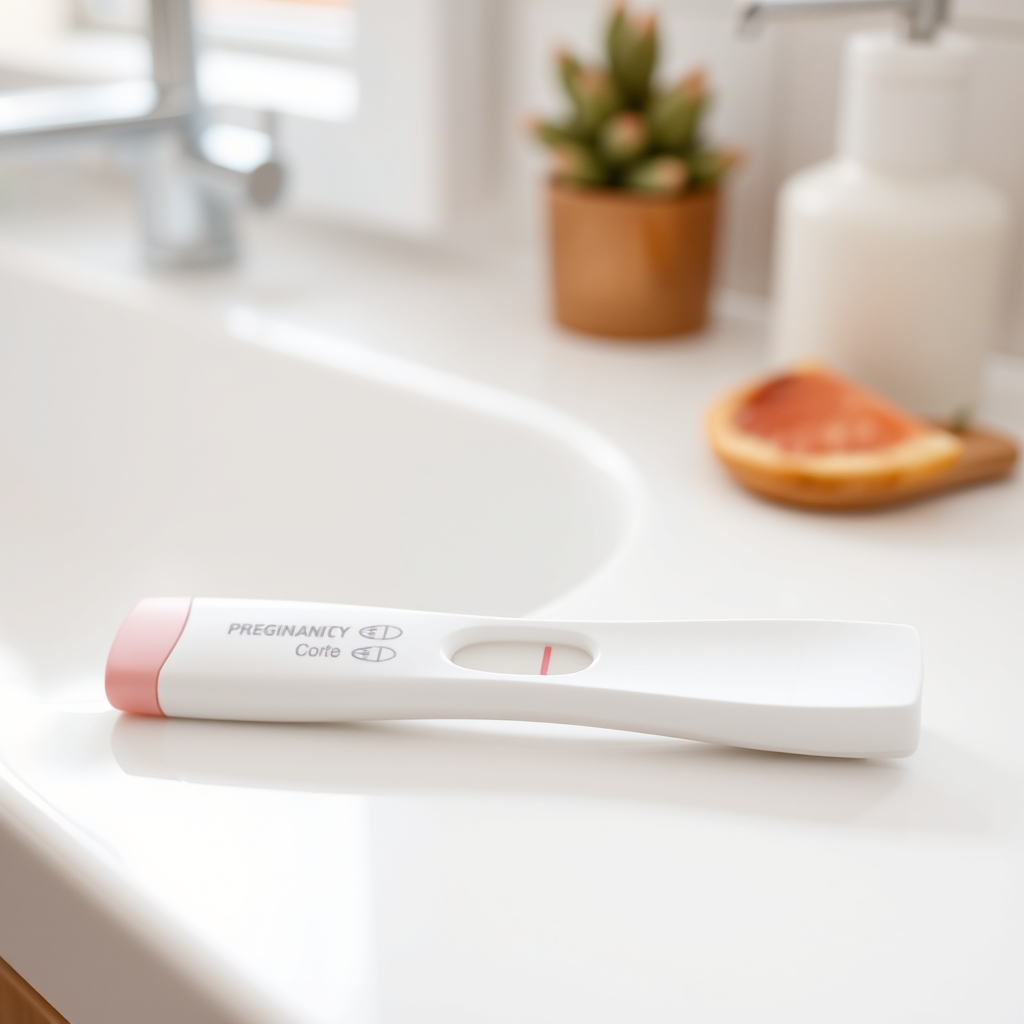
A light line on a pregnancy test can be confusing, learn how to interpret results and what it means for your pregnancy with our expert guide and advice
By Shubhra Mishra — a mom of two who turned her own confusion during pregnancy into BumpBites, a global mission to make food choices clear, safe, and stress-free for every expecting mother. 💛
Check whether any food is safe during pregnancy with the BumpBites Food Safety Checker.
Quick take: A light or faint line on a home pregnancy test usually means that the test has detected the pregnancy hormone hCG, but at a low level. It can be an early positive, a diluted urine sample, or a test that is nearing its expiration—so retest in a day or two and talk to your provider if you’re unsure.
It’s 6 a.m., you’re still half‑asleep, and the bathroom mirror shows a tiny pink line where you expected a bold “+”. Your mind races: “Did I just get my result or is this a mistake?” You’re not alone. Many people experience that moment of uncertainty, and the good news is the answer is often clear once you understand how pregnancy tests work.
In this guide we’ll demystify that faint line, explain what it says about your body’s hormone levels, and walk you through the next steps—whether that means a repeat test, a visit to your clinician, or simply a little patience. We’ll also cover why some tests show a faint line, how to read them correctly, and what factors like medication or urine concentration can affect the result.
What does a faint line on a pregnancy test mean?
A faint line on the result window indicates that the test has detected human chorionic gonadotropin (hCG), the hormone produced by the placenta after implantation. Most home tests are designed to show a dark line when hCG levels are above a certain threshold—usually 25 mIU/mL for the “standard” sensitivity. When the line appears light, it typically means the hCG concentration is just above the test’s detection limit but still relatively low.
Early in pregnancy, especially before a missed period, hCG levels can be anywhere from 5 to 50 mIU/mL. Because the hormone doubles roughly every 48‑72 hours, a faint line often signals that you’re at the very beginning of that rise. In many cases, the line will become darker within 24‑48 hours as hCG climbs.
It’s also possible that a faint line is a result of diluted urine, which reduces the concentration of hCG reaching the test strip. If you’ve been drinking a lot of fluids before testing, the line may look pale even if your body is producing a healthy amount of hormone.
Finally, a faint line can appear when a test is close to its expiration date or has been stored in a hot environment, which can weaken the chemical reagents. In such cases the line may be unreliable, and a fresh test is advisable.
Bottom line: a light line most often means a very early positive, but it’s worth confirming with a repeat test and, if needed, a blood hCG measurement from your provider.
Because hCG levels vary widely between individuals, a faint line does not predict the eventual size of the pregnancy or any complications. The key is to track the trend with follow‑up testing rather than to read too much into a single result.
How to read a light line on a home pregnancy test
Reading a home pregnancy test correctly starts with the basics: follow the manufacturer’s instructions, use the right amount of urine, and wait the specified time—usually 3 to 5 minutes—before interpreting the result. The result window typically has two markers: a control line (C) that confirms the test worked, and a test line (T) that indicates hCG.
A light or faint test line is still considered a positive result, as long as the control line appears solid. The key is to compare the intensity of the test line to the control line. If the test line is barely visible but present, most manufacturers label it as “positive” because any visible line means hCG was detected.
To avoid misreading, do the following:
Check the timing. Read the result within the window indicated in the instructions (usually 3–5 minutes). Reading too early can miss a faint line; reading too late can cause evaporation lines that look faint but are not true results.
Look in good lighting. A bright, natural light source helps you see subtle lines. A dim bathroom light can make a faint line look nonexistent.
Use a mirror. Holding the test up to a mirror can help you see the line from a different angle.
Don’t rely on a phone camera. Photos can distort the line’s darkness.
If you’re still unsure, take a second test with a new kit after 24 hours. A darker line on the repeat test usually confirms pregnancy. If the line stays faint or disappears, consider factors like urine dilution or test validity (see the section on invalid tests).
Another tip is to keep a short log of the date, time, and any medications you’re taking. This information can be helpful for your clinician when you discuss the result, especially if you’re using fertility treatments that contain hCG.
Can a light pink line indicate pregnancy?
Yes. Most pregnancy tests use a pink or blue dye that appears on the test line when hCG binds to the antibodies on the strip. A light pink line means that binding occurred, but at a lower concentration than a bold, dark line would show.
The color itself—pink, blue, or sometimes purple—doesn’t change the meaning. What matters is whether the line is present at all. Even a very pale pink line is a positive result according to FDA guidelines, which state that any visible line in the test region, regardless of shade, should be interpreted as “positive”.
Some users mistake a faint pink line for a “maybe” result, but the reality is that home tests are calibrated to flag any hCG detection. The line’s intensity correlates with hormone level, not with certainty. Therefore, a light pink line is a reliable early indicator that implantation has occurred.
If you see a light pink line, the next steps are to:
Record the date and time of the test.
Retest in 48 hours using a fresh test.
Consider a blood test for quantitative hCG if you need a precise level.
These actions will give you a clearer picture of how quickly your hCG is rising, which can be reassuring for both you and your provider.
Remember that a faint line does not indicate the health of the pregnancy; it only confirms that hCG is present. For information about early‑pregnancy health, consult reputable sources such as the NHS or ACOG.
Why is my pregnancy test line faint and disappearing?
A line that appears faint and then vanishes is often the result of evaporation. After the recommended reading window, the urine evaporates from the test strip, leaving behind a faint “ghost” line that can fade away. This is why manufacturers stress reading the result within a specific time frame.
Another possibility is that the test is detecting a very low hCG level that drops out of the detection range as the urine dries. In this scenario, the line may look bright at first and then fade as the concentration thins out.
Test quality can also play a role. An expired or heat‑exposed test may produce a weak line that isn’t stable. If the test packaging is torn, or the test was stored in a humid environment, the reagents may not function consistently, leading to a line that appears and then disappears.
To avoid confusion, always:
Read the result at the exact time recommended (usually 3‑5 minutes).
Take a photo immediately after reading if you need documentation.
Retest with a new kit if the line was faint and then disappeared.
If you’re consistently getting faint lines that disappear, it may be time to discuss a blood hCG test with your clinician to get a definitive answer.
Clinicians often recommend a quantitative serum hCG measurement when home test results are ambiguous, because the blood test can detect hCG levels as low as 1 mIU/mL and provides a numeric value to track over time.
Difference between positive and faint line on pregnancy test
The difference is primarily one of intensity, not of meaning. A “positive” line in most test instructions refers to any visible line, even if it’s faint. However, many people perceive a bold, dark line as a “strong positive” and a faint line as “maybe”. This perception can cause unnecessary anxiety.
Here’s a quick visual guide:
Line intensity
What it usually means
Typical hCG range
Dark, solid
Established pregnancy (usually >150 mIU/mL)
150 mIU/mL +
Medium shade
Early pregnancy, hCG rising
25–150 mIU/mL
Light/faint
Very early pregnancy or diluted urine
5–25 mIU/mL
No line
Negative (hCG below detection)
Below 5 mIU/mL
Even a faint line is a positive according to the test’s chemistry. The main practical difference is that a faint line often appears earlier, before you miss your period, and may become darker as the hormone rises. A dark line typically appears after a missed period and signals that hCG levels are well established.
If you’re unsure whether a faint line is a true positive, the safest approach is to repeat the test in 48 hours and, if still positive, schedule a prenatal appointment. Your provider can perform a quantitative blood test that tells you the exact hCG level, removing any ambiguity.
It’s also worth noting that some clinicians use the term “early positive” to describe faint lines, emphasizing that the result is reliable but that the pregnancy is still in its first few weeks.
Is a faint line on a pregnancy test a false positive?
False positives—where a test shows a line even though you’re not pregnant—are rare but can happen. The most common reasons for a false‑positive faint line include:
Recent pregnancy loss. Residual hCG can linger for up to two weeks after a miscarriage or abortion, producing a faint line.
Fertility medications. Drugs that contain hCG (e.g., certain forms of injectable gonadotropins) can trigger a positive result even without pregnancy.
Medical conditions. Rare tumors that produce hCG, such as certain cancers of the ovary or placenta, can cause a false positive.
Contamination. Contact with another person’s urine or a cleaning solution containing hCG can create a misleading line.
In most everyday scenarios, a faint line is not a false positive but an early true positive. To rule out a false positive, consider your recent medical history. If you’ve taken fertility drugs, had a recent miscarriage, or have a condition that might produce hCG, discuss the result with your provider.
When in doubt, a blood hCG test is the gold standard. It can differentiate between a true pregnancy and a false positive by measuring the exact hormone concentration and its pattern over time.
According to ACOG, a false‑positive rate for home pregnancy tests is less than 1 %, reinforcing that most faint lines you see are genuinely indicative of pregnancy.
How long does it take for a faint line to appear on a pregnancy test?
The timing depends on two factors: the sensitivity of the test and how many days have passed since implantation. Most over‑the‑counter tests claim to detect hCG as early as 6‑8 days after ovulation (roughly 4‑5 days before a missed period). At that point, the hormone level may be just above the detection threshold, resulting in a faint line.
If you test on the day of a missed period, many users see a faint line that becomes darker the next day. Studies cited by the CDC show that the average time for a faint line to turn into a solid line is about 24‑48 hours, reflecting the natural doubling of hCG.
Testing too early—before the embryo has implanted or before the hCG level reaches the test’s threshold—will typically yield a negative result. That’s why many experts, including the American College of Obstetricians and Gynecologists (ACOG), recommend waiting until at least the first day of a missed period for the most reliable result.
In practice, if you see a faint line before your period is due, give it 48 hours and test again. If the line darkens, you’ve likely confirmed an early pregnancy. If it stays faint or disappears, consider a blood test for confirmation.
Remember that individual hormone curves vary; some people’s hCG may rise more slowly, so a faint line can persist for several days before becoming darker.
What factors cause a light line on a pregnancy test?
Beyond the natural rise of hCG, several external factors can influence the appearance of a light line:
Urine concentration. Diluted urine (from excess fluid intake) reduces hCG density, producing a fainter line. Testing first‑morning urine, which is more concentrated, often yields a darker line.
Test sensitivity. Brands differ: some detect as low as 10 mIU/mL (high sensitivity), while others need 25 mIU/mL. A high‑sensitivity test is more likely to show a faint line early.
Medications. Certain fertility drugs contain hCG, and some anticonvulsants or diuretics can affect urine composition, potentially altering test results.
Timing. Testing too soon after a missed period can give a faint line; waiting 24‑48 hours after a negative test can improve accuracy.
Storage conditions. Exposure to heat, humidity, or direct sunlight can degrade the chemicals on the test strip, leading to weaker lines.
User error. Adding too much or too little urine, or not waiting the correct amount of time before reading, can affect line visibility.
Understanding these variables helps you interpret a faint line more confidently. For most people, the simplest solution is to test with first‑morning urine, use a fresh, unexpired kit, and follow the instructions precisely.
Additionally, some studies from the NHS suggest that a modest amount of caffeine (under 200 mg per day) does not affect hCG detection, but extreme dehydration from excessive coffee can dilute urine and make lines fainter.
Testing first‑thing in the morning often yields a clearer result.
From our medical team: A faint line is usually a sign of early pregnancy, not an error. However, because hCG levels double every few days, we recommend a repeat test after 48 hours and a blood test if you need confirmation. If you have any concerns—especially if you’re on fertility medication or have a recent miscarriage—reach out to your provider sooner rather than later.
Can a faint line help estimate how far along I am?
While a faint line tells you that hCG is present, it does not provide a precise gestational age. Home tests are designed only to detect the presence of the hormone, not to quantify it. To estimate how many weeks pregnant you are, clinicians rely on quantitative serum hCG levels and, later, on ultrasound measurements.
For example, a serum hCG of 5 mIU/mL typically corresponds to about 3 weeks since the last menstrual period, but the same value could represent a later stage in a different individual. Because hCG rise rates vary, a faint line on a urine test cannot reliably replace a professional dating scan.
If you’re eager for an accurate dating, schedule an early ultrasound (usually between 6–9 weeks gestation). This not only confirms the pregnancy but also provides a reliable estimate of fetal age, which is important for prenatal care planning.
How do lifestyle factors like diet, caffeine, and exercise influence faint lines?
Dietary habits can affect urine concentration, which in turn influences how a pregnancy test line appears. High‑water intake, while healthy, may dilute urine and make a true positive appear faint. Conversely, moderate dehydration can concentrate urine, potentially making a faint line appear darker.
Caffeine consumption, especially from coffee or energy drinks, does not directly interfere with hCG detection, but excessive caffeine can increase urine output, leading to dilution. The NHS advises limiting caffeine to 200 mg per day during pregnancy, a guideline that also applies when testing.
Intense exercise before testing can also lead to temporary dehydration. If you’ve just finished a vigorous workout, consider waiting until you’ve rehydrated before taking the test, or simply use first‑morning urine to avoid this variable.
What should I do if I have irregular periods or PCOS and see a faint line?
Irregular cycles, such as those caused by polycystic ovary syndrome (PCOS), can make timing ovulation—and therefore the optimal testing window—more challenging. In these cases, a faint line may appear earlier or later than expected, and spotting can be mistaken for a menstrual bleed.
When you have irregular periods, it’s helpful to use ovulation predictor kits (OPKs) in conjunction with home pregnancy tests. An OPK that shows a surge in luteinizing hormone (LH) can indicate that implantation is likely to occur within the next 6‑12 days, giving you a clearer window for testing.
If you suspect pregnancy and have a faint line, repeat the test after 48 hours and consider a serum hCG test. Your provider may also recommend an early ultrasound to confirm the pregnancy’s location, especially if you have a history of ectopic pregnancy associated with PCOS.
Myth vs. fact
Myth: A faint line means the test is broken.
Fact: Most tests are designed to show any line as a positive. A faint line usually reflects low hCG, not a faulty device.
Myth: You can’t get pregnant if the line is light.
Fact: Pregnancy can be detected at very low hCG levels, which appear as light lines. Early detection is common and often reassuring.
Myth: Drinking lots of water will make the line darker.
Fact: Excessive water dilutes urine, which can actually make the line fainter. Testing with concentrated, first‑morning urine is best.
Key takeaways
A faint line indicates that hCG is present, often signalling early pregnancy.
Read the result within the manufacturer’s time window and use first‑morning urine for best accuracy.
Retest in 24‑48 hours; a darker line usually confirms pregnancy.
Consider factors like medication, urine dilution, and test expiration if the line is unusually light.
If you’re on fertility drugs, have recent miscarriage, or see persistent faint lines, contact your provider for a blood hCG test.
Never rely on a single home test for definitive answers—follow up with a healthcare professional.
Frequently asked questions
Can a faint line on a pregnancy test be a positive result?
Yes. According to FDA guidance, any visible line in the test area, no matter how light, is considered a positive result because it means hCG was detected.
How soon can a pregnancy test show a faint line?
A high‑sensitivity test can show a faint line as early as 6 days after ovulation, which is often 4‑5 days before a missed period.
What does a gray line on a pregnancy test mean?
A gray line usually indicates an invalid test—often caused by a faulty kit, improper storage, or using the wrong type of urine. Retake the test with a new device.
Why does my pregnancy test show a light line and then disappear?
The line may fade after the recommended reading window due to evaporation. Read the result within 3‑5 minutes, then retest if you missed the window.
Is a faint line on a pregnancy test a false negative?
No. A faint line is a positive. A false negative occurs when no line appears despite pregnancy, usually because hCG levels are still below the test’s detection threshold.
Do different brands of pregnancy tests have different line sensitivities?
Yes. Some brands detect hCG as low as 10 mIU/mL, while others require 25 mIU/mL. Higher‑sensitivity tests are more likely to show faint lines earlier.
Can a faint line be caused by a urinary tract infection?
Generally, a urinary tract infection (UTI) does not affect the hCG detection chemistry, so a faint line is still a true positive. However, a UTI can change urine composition and, in rare cases, dilute the sample, making the line appear lighter.
Is it safe to use a home pregnancy test while on hormonal birth control?
Yes. Hormonal contraceptives do not contain hCG, so they do not cause false positives. If you suspect pregnancy while on birth control, a faint line should be taken seriously and followed up with a repeat test or blood work.
When to call your doctor
If you experience any of the following, contact your healthcare provider right away: heavy abdominal pain, severe cramping, spotting with a faint line, fever, or if you suspect a false positive due to recent fertility medication. Remember, this article is for information only and does not replace personalized medical advice.
References
American College of Obstetricians and Gynecologists (ACOG). “Early Pregnancy Testing.” 2023 Clinical Guidance.
U.S. Food and Drug Administration (FDA). “Pregnancy Test Kits: Consumer Information.” Updated 2022.
Centers for Disease Control and Prevention (CDC). “Human Chorionic Gonadotropin (hCG) Levels in Early Pregnancy.” 2021.
National Health Service (NHS) England. “How to Use a Home Pregnancy Test.” 2023.
World Health Organization (WHO). “Guidelines on the Use of Urine Pregnancy Tests.” 2022.
Mayo Clinic. “Pregnancy test: what the results mean.” Accessed July 2024.
Society for Assisted Reproductive Technology (SART). “Impact of Fertility Medications on Pregnancy Test Results.” 2022.
National Institute for Health and Care Excellence (NICE). “Testing for Pregnancy.” 2023.
Not sure about the label on Light Line On A Pregnancy Test How To Interpret Results products?
Snap the ingredients list and SafeFilter checks every ingredient for your stage — only 3 free scans this month, then you're locked until reset. Unlimited from $7/mo or $50/yr.
When Shubhra Mishra was expecting her first child in 2016, she was overwhelmed by conflicting food advice — one site said yes, another said never. By the time her second baby arrived in 2019, she realized millions of mothers face the same confusion.
That sparked a five-year journey through clinical nutrition papers, cultural diets, and expert conversations — all leading to BumpBites: a calm, compassionate space where science meets everyday motherhood.
Her long-term vision is to build a global community ensuring safe, supported, and free deliveriesfor every mother — because no woman should face pregnancy alone or uninformed. 🌿
🌍 Stand with mothers, shape safer guidance
Join a small circle of experts who review BumpBites articles so expecting parents everywhere can decide with confidence.