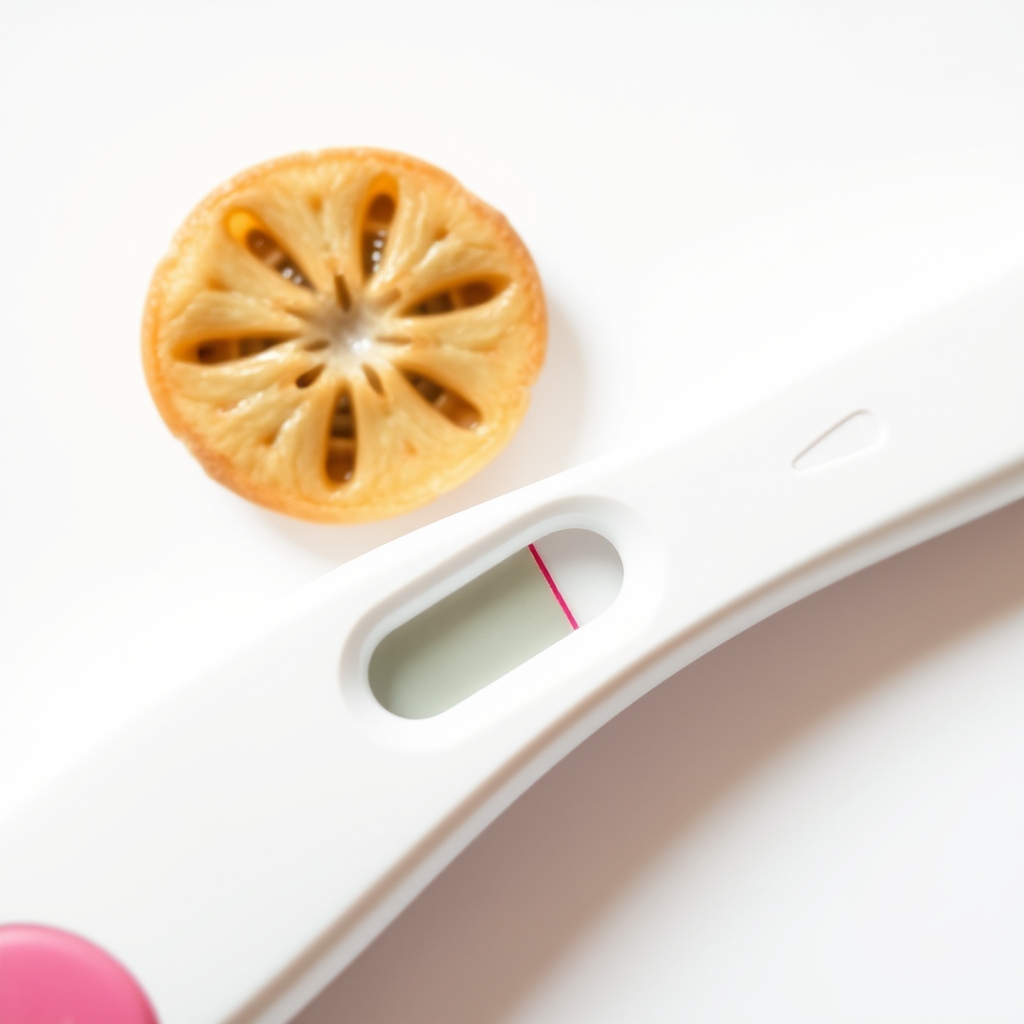
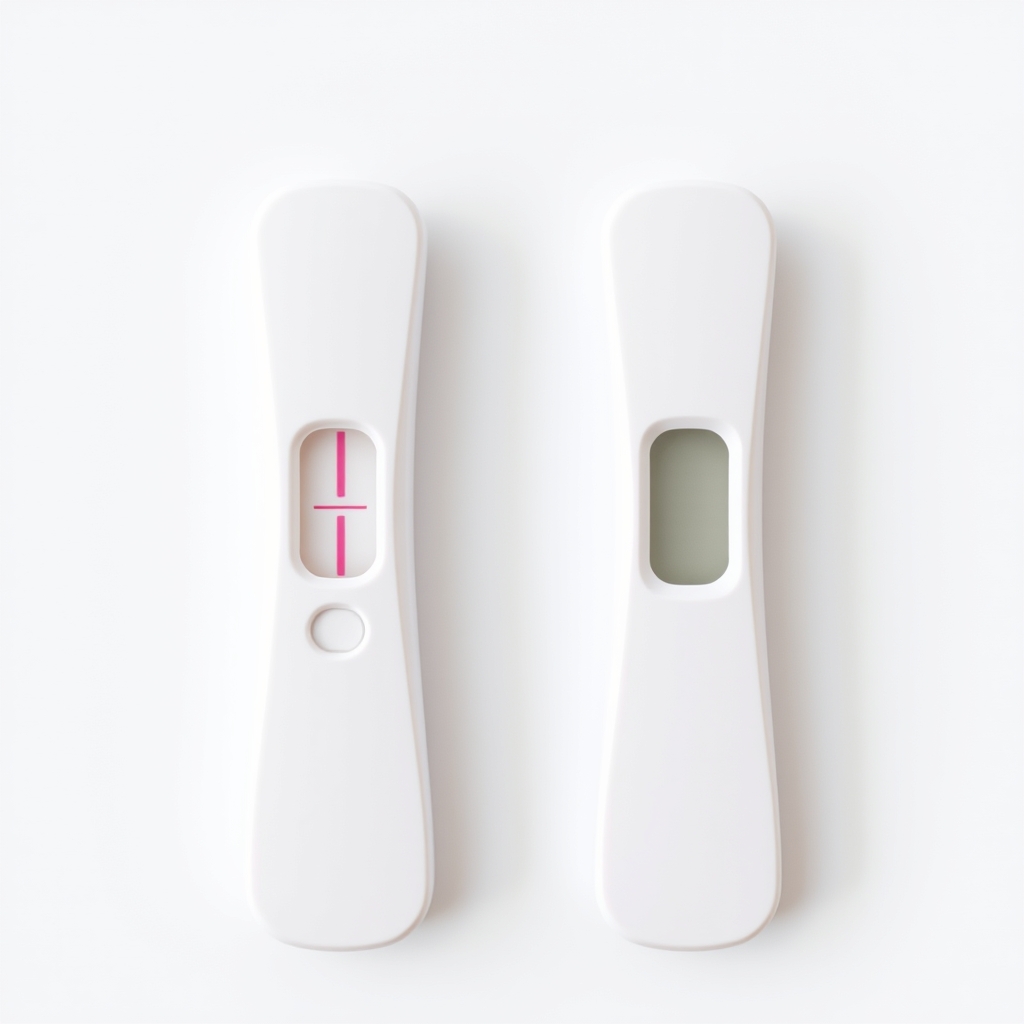
A faint line on a pregnancy test usually means a positive result, indicating early pregnancy; it appears when hCG levels are low and can vary in intensity. Read on to understand why it shows up and when to retest.
By Shubhra Mishra — a mom of two who turned her own confusion during pregnancy into BumpBites, a global mission to make food choices clear, safe, and stress-free for every expecting mother. 💛
Check whether any food is safe during pregnancy with the BumpBites Food Safety Checker.
Quick take: A faint line on a pregnancy test usually means there is some hCG in your urine, but the amount is low enough that the result is borderline. It can be an early pregnancy, a diluted urine sample, a chemical (very early) pregnancy, or even a test‑related artifact. Retest with first‑morning urine in a few days, and if you keep seeing a line—or have any concerning symptoms—follow up with your provider for a blood hCG test.
It’s 2 a.m., you’re curled up on the couch, and the pregnancy test you bought on a whim has just shown a barely visible line. Your heart races. “Is this even a positive?” you wonder, scrolling for answers while the house is quiet. You’re not alone; millions of people wake up to this exact moment, and the uncertainty can feel overwhelming.
First, breathe. A faint line is not a panic button—it’s a clue. In most cases it signals that your body is producing the pregnancy hormone hCG, but the level is still low. That can happen if you’re testing very early, if your urine is diluted, or if the test is reacting to a chemical pregnancy that ends before you even notice a missed period.
In this guide we’ll break down the science behind those delicate lines, explain why they appear, show you how to tell a true result from a trick of evaporation, and give you a step‑by‑step plan for retesting and getting the care you need. By the end you’ll know exactly what a faint line means for you and what the safest next steps are.
Even a barely visible line can be a signal that hCG is present.
Is a very faint line on a pregnancy test positive?
Short answer: Yes, a faint line usually counts as a positive result. Most over‑the‑counter tests are designed to show any amount of human chorionic gonadotropin (hCG) that reaches the test’s detection threshold. If the line appears within the manufacturer’s recommended window—typically 3–10 minutes after you dip the strip—it is interpreted as “positive,” even if the line is barely darker than the background.
Why does the line look faint? The intensity of the line correlates with the concentration of hCG in your urine. Early in pregnancy, or when you’re well hydrated, hCG levels can be low enough that the test’s control line (the “C” line) looks strong while the result line (the “T” line) is just a whisper of pink.
Most brands set their sensitivity around 25 mIU/mL of hCG, but some “early‑detection” tests can pick up as low as 6 mIU/mL. At those low levels the line may be faint, especially if the urine is not concentrated. In short, a faint line is a positive, but it tells you that the hormone level is still on the low side.
What the test is actually measuring
hCG basics: hCG is a hormone made by the placenta after a fertilized egg implants. It first appears in the bloodstream about 6–12 days after fertilization and then leaks into urine.
Detection limits: The lower the detection limit, the earlier a test can show a result. For example, First Response Early Result advertises detection at 6.3 mIU/mL, while Clearblue Early Pregnancy Test detects around 10 mIU/mL.
Line intensity: The chemical reaction that creates the line is proportional to hCG concentration. Low hCG = faint line; higher hCG = darker line.
Because the test is essentially a visual read‑out of a biochemical reaction, the line’s darkness is not a precise measurement. However, clinicians use the presence of any line within the reading window as a reliable indicator that pregnancy is possible, prompting further confirmation.
What causes a faint positive pregnancy test line?
Several factors can leave you with a barely visible “T” line. Understanding them helps you decide whether to retest, wait, or seek care.
Early pregnancy
If you’ve just ovulated and the embryo has only recently implanted, hCG may still be low. Testing before your period is late—or even a few days after conception—can produce a faint line that darkens over the next 48‑72 hours as hCG rises.
Early‑pregnancy implantation can vary widely—some women see a faint line as soon as five days after ovulation, while others need a full week for hormone levels to climb enough for a darker line. This variability is why many providers recommend waiting until you miss your period before taking a test, unless you’re using a highly sensitive brand.
Diluted urine
Drinking a lot of water, coffee, or juice before testing dilutes the urine, spreading the hCG molecules thinly. The same amount of hormone in a larger volume appears weaker on the test strip, leading to a faint line.
Even mild hydration can affect the result. A study published by the NHS in 2022 found that participants who drank more than 500 ml of fluid within two hours before testing were 30 % more likely to receive a faint or negative result despite being pregnant.
Test type and sensitivity
Not all tests are created equal. Digital tests, for example, display “positive” or “negative” rather than a line, but they still rely on the same biochemical reaction. Some brands—especially older or budget models—have higher detection thresholds, so a faint line may be the only sign they can give at low hCG levels.
Choosing a test with a lower detection threshold (often marketed as “early‑detection”) can increase the chance of spotting a faint line earlier, but it also raises the possibility of a false‑positive if the test picks up trace hCG from a recent miscarriage or certain medical conditions.
Medications and medical conditions
Certain fertility drugs (like hCG injections) or medical conditions that raise hCG (e.g., certain cancers) can influence results. However, these situations are rare, and most faint lines are linked to early pregnancy or diluted urine.
If you’re on fertility medication, the exogenous hCG can cause a false‑positive urine test. In that case, a serum hCG test is the gold standard because it can differentiate between endogenous (produced by your body) and exogenous hormone levels.
How soon can a pregnancy test show a faint line?
You can see a faint line as early as six days after fertilization, though most women notice it around the time of a missed period. The exact timing depends on how quickly your body produces hCG and how concentrated your urine is.
First‑morning urine advantage
Overnight, your kidneys concentrate urine, making the first‑morning sample the most reliable for low‑level hCG detection. If you test later in the day and are well‑hydrated, the line may be faint or even invisible.
Because the first‑morning sample is naturally more concentrated, many clinicians advise waiting until you can collect that sample before drawing conclusions from a faint line seen later in the day.
Case example
Emma, 28, tracked her cycle and ovulated on June 5. She tested on June 10—five days later—with a digital test that showed “negative.” She tried again on June 12, using a line‑type test, and saw a barely pink line. Two days later the line darkened, confirming pregnancy. Emma’s story illustrates how a faint line can appear as early as eight days after ovulation.
Emma also learned that waiting to test with her first‑morning urine would have given her a clearer result the first time, saving her a day of anxiety.
Faint line on pregnancy test but no period – what does it mean?
If you see a faint line and your period is late, the most common explanation is a very early pregnancy. The hormone is present, just not yet at a level that creates a bold line.
Other possibilities include:
Implantation bleeding: Some women experience light spotting when the embryo embeds, which can be mistaken for a period.
Stress or hormonal shifts: Factors like intense exercise, weight loss, or thyroid issues can delay menstruation and affect hCG readings.
Chemical pregnancy: A fertilized egg that fails to develop beyond a few weeks can still produce enough hCG for a faint line before the body re‑absorbs it.
Because a faint line already indicates hCG, the safest route is to confirm with a blood test, which can detect hCG at levels as low as 1 mIU/mL and differentiate between a viable pregnancy and a chemical loss.
In the United Kingdom, NHS guidance advises that any positive urine test—faint or strong—should be followed up with a serum hCG if the woman is experiencing bleeding or pain, to rule out ectopic pregnancy or miscarriage.
When should I retest after a faint positive pregnancy test?
Give your body a little time to catch up. The general recommendation is to wait 48‑72 hours and use the first‑morning urine for a repeat test. If the line becomes darker, you’re likely seeing a normal rise in hCG.
Step‑by‑step retesting plan
Mark the day: Write down the date and time you first saw the faint line.
Hydrate strategically: Avoid excessive fluids for at least an hour before your next test; you want a concentrated sample.
Use the same brand: Switching brands can change detection thresholds, making comparisons harder.
Read within the window: Most tests are valid for 3–10 minutes. After that, evaporation lines may appear.
Record the result: Take a photo of the test strip for reference.
If after two attempts the line stays faint or disappears, consider a blood hCG test. It will give you a precise number and help your provider decide the next steps.
ACOG’s Practice Bulletin No. 194 (2022) notes that a rising hCG level—doubling roughly every 48 hours in early pregnancy—is a reassuring sign of a viable intrauterine pregnancy, while flat or declining levels warrant further evaluation.
How can I tell a faint line from an evaporation line?
Evaporation lines are a common source of confusion. They usually appear after the recommended reading window—often 10‑15 minutes after testing—and are colorless or very faint gray, not pink. Here’s how to differentiate them:
Timing: A true result line appears within the test’s official window (usually 3‑10 minutes). Anything that shows up after that is likely an evaporation artifact.
Color: Positive lines are pink or blue (depending on the brand). Evaporation lines are typically colorless, faint, or gray.
Location: Evaporation lines often appear near the test’s edge, whereas the “T” line is positioned directly between the control and test markers.
When in doubt, take a photo at the exact minute mark and compare it to the control line. If the line is still faint but clearly pink within the window, it counts as positive.
Some manufacturers now include a “no‑line” control that appears only when the test is valid, helping users identify evaporation artifacts more easily.
Can a faint line on a pregnancy test be a chemical pregnancy?
Yes. A chemical pregnancy is a very early loss that occurs before you would normally notice a missed period. The embryo may implant, produce hCG, and then stop developing. Because the hormone level never rises very high, the test often shows only a faint line.
Most chemical pregnancies resolve on their own, and the faint line fades as hCG is cleared from the body—usually within a week. If you notice a faint line followed by a negative test a few days later, it’s a classic sign of a chemical pregnancy.
While a chemical pregnancy can be emotionally distressing, it’s not usually a sign of underlying fertility problems. If you experience multiple early losses, however, it’s worth discussing with a specialist who can evaluate hormonal and uterine factors.
RCOG’s Green‑top Guideline No. 73 (2021) recommends a serum hCG measurement after a suspected chemical pregnancy to confirm the decline and to rule out ectopic implantation.
What does a faint line mean after the test window?
If you see a faint line after the manufacturer’s reading window, it’s most likely an evaporation line, not a true positive. These lines are not a reliable indicator of hCG and should be ignored.
To avoid this confusion, always set a timer when you start the test and read the result within the specified minutes. If you missed the window, discard the test and use a fresh one.
FDA guidance on home pregnancy test labeling emphasizes clear instructions about timing to reduce user error, underscoring the importance of reading results promptly.
Timing and color help you tell a true faint line apart from an evaporation artifact.
Understanding the numbers: How test sensitivity relates to faint lines
The table below summarizes the detection thresholds of several popular over‑the‑counter tests and shows how a faint line typically corresponds to low hCG concentrations.
Brand
Detection threshold (mIU/mL)
Typical appearance at threshold
Recommended use
First Response Early Result
6.3
Very faint pink line
Can be used up to 6 days before missed period
Clearblue Early Pregnancy Test
10
Faint pink line
Accurate from the day of missed period
e‑Pill Pregnancy Test (Digital)
25
Digital “positive” display; no line intensity
Best for testing after missed period
Acumerica Ultra‑Sensitive
7
Very faint line, sometimes hard to see
Detects pregnancy as early as 5 days before missed period
Notice that the tests with the lowest detection thresholds are the ones most likely to give you a faint line when you’re testing very early. If you’re using a test with a higher threshold, a faint line may not appear until hCG has risen enough to produce a darker line.
Because the sensitivity varies, many clinicians advise patients who receive a faint line on a higher‑threshold test to repeat the test with a more sensitive brand or to proceed directly to a serum hCG test for clarification.
From our medical team: A faint line is a signal, not a diagnosis. The safest way to confirm a pregnancy—especially if you’re experiencing symptoms like cramping, spotting, or if you have a history of early loss—is to schedule a serum hCG blood test. It gives a precise hormone level, tells you whether the pregnancy is progressing, and helps rule out false‑positive causes.
How does a faint line affect next‑step planning for prenatal care?
Even a faint positive result should prompt you to think about early prenatal care. While you may not yet have a confirmed pregnancy, many providers recommend beginning prenatal vitamins (especially folic acid) as soon as you suspect pregnancy. Starting folic acid before conception reduces the risk of neural‑tube defects, and a faint line is a perfect reminder to begin supplementation.
If you’re a smoker, drinking alcohol, or taking prescription medications, a faint line is a cue to discuss these habits with your provider. Early counseling can help you adjust lifestyle factors that influence fetal development, even before an ultrasound confirms a gestational sac.
In the United States, ACOG advises that any positive home test—faint or strong—should be followed by a prenatal visit within two weeks. During that visit, your clinician will likely order a serum hCG and possibly a transvaginal ultrasound to determine gestational age and assess viability.
Can medications, supplements, or medical conditions create a false‑positive faint line?
Yes, though it’s uncommon. Certain medications that contain hCG (such as fertility treatments) can cause a urine test to turn positive even if you’re not pregnant. Likewise, some immunoassays can cross‑react with similar hormones like luteinizing hormone (LH), especially if you’re taking high‑dose fertility drugs.
Medical conditions that produce hCG include certain trophoblastic diseases (e.g., molar pregnancy) and some cancers (like choriocarcinoma). In these cases, hCG levels are usually much higher than what a faint line would suggest, but a very early tumor could theoretically produce a low‑level positive.
If you’re on fertility medication or have a known hCG‑producing condition, let your provider know before testing. They may recommend a serum hCG that distinguishes between endogenous and exogenous hormone sources.
When is a blood hCG test recommended over a urine test?
A serum (blood) hCG test is more sensitive than any home urine test, detecting levels as low as 1 mIU/mL. It is recommended when:
You have a faint line and need confirmation before an important appointment (e.g., a scheduled surgery).
You experience bleeding, cramping, or other concerning symptoms that could signal an ectopic pregnancy.
You are undergoing fertility treatment that involves hCG injections.
Your provider wants to track the exact rise of hCG to assess viability (a rise of ~66 % every 48 hours is typical for a healthy early pregnancy).
Blood testing also helps differentiate a chemical pregnancy from a viable intrauterine pregnancy, because the rate of hCG increase (or decrease) provides a clear picture of embryonic development.
Both the NHS and ACOG recommend a serum hCG if a patient presents with a faint line plus any of the above red‑flag symptoms, as it allows for rapid, accurate triage.
From our medical team: If you’re on hCG‑containing fertility medication, a faint line on a urine test is expected and does not necessarily indicate a natural pregnancy. In those cases, a serum hCG drawn at least 12 hours after the last injection gives the most reliable picture.
Myth vs. fact
Myth: A faint line always means you’re pregnant.
Fact: While a faint line within the test’s reading window is considered positive, it can also result from evaporation artifacts, diluted urine, or a chemical pregnancy that ends quickly.
Myth: You should wait until the line darkens before calling a doctor.
Fact: If you have any concerning symptoms—such as heavy bleeding, severe cramping, or fever—call your provider right away, regardless of line intensity.
Myth: Digital tests never show faint lines.
Fact: Digital tests display “positive” or “negative,” but they rely on the same hCG detection chemistry. If the hormone level is borderline, the device may still register a positive result, even if a line‑type test would only show a faint line.
Key takeaways
A faint line within the test’s reading window is considered a positive result, indicating low‑level hCG.
Early pregnancy, diluted urine, and high‑sensitivity tests are the most common reasons for a faint line.
Retest in 48‑72 hours using first‑morning urine and the same brand for the most reliable comparison.
Distinguish true faint lines from evaporation lines by checking timing, color, and location.
If the line stays faint, disappears, or you have concerning symptoms, schedule a serum hCG blood test.
Start prenatal vitamins (especially folic acid) as soon as you suspect pregnancy, and discuss any medications or lifestyle factors with your provider.
Always talk to your provider if you’re unsure—especially after a miscarriage, if you’re on fertility medication, or if you have underlying health conditions.
Frequently asked questions
How faint can a positive pregnancy test be?
A positive line can be so light that it looks like a shadow, but as long as it appears within the test’s recommended time frame and has a pink or blue hue, it counts as a positive result.
Is a faint line always positive?
Within the reading window, yes—a faint line is interpreted as positive. Outside that window, a faint mark is likely an evaporation line and should not be considered a true result.
What does a faint line on a pregnancy test mean early?
Early in pregnancy, hCG levels are low, so the test may only produce a faint line. This usually indicates that implantation has occurred but the hormone has not yet risen enough to create a darker line.
When should I retest if I have a faint line?
Wait 48‑72 hours and use first‑morning urine. If the line darkens, the pregnancy is progressing; if it stays faint or disappears, a blood test can clarify the situation.
Can an evaporation line be mistaken for a positive?
Yes. Evaporation lines appear after the test’s official reading window and are typically colorless or gray. Always read the result within the manufacturer’s time frame to avoid confusion.
What is a chemical pregnancy and how does it relate to faint lines?
A chemical pregnancy is an early loss that occurs before the embryo can develop. Because hCG never rises high, the test often shows only a faint line, which may disappear on subsequent testing.
Should I start prenatal vitamins if I only have a faint line?
Yes. Starting a prenatal vitamin with at least 400 µg of folic acid as soon as you suspect pregnancy is recommended by both ACOG and NHS guidelines, even if the result is still faint.
Can a faint line be caused by a medication I’m taking?
Some fertility drugs contain hCG and can cause a urine test to turn positive. If you’re on such medication, a serum hCG drawn after the last dose gives the most accurate picture.
When to call your doctor
If you experience any of the following, contact your healthcare provider promptly: heavy bleeding (soaking a pad in under an hour), severe abdominal pain, fever, dizziness, or if you have a known medical condition that affects hCG (e.g., certain cancers). Remember, this article is for information only and does not replace personalized medical advice.
References
American College of Obstetricians and Gynecologists (ACOG). “Early Pregnancy Testing.” Practice Bulletin No. 194, 2022.
U.S. Food and Drug Administration (FDA). “Home Pregnancy Test Guidance for Industry.” 2021.
National Health Service (NHS). “Pregnancy test: how it works and when to use it.” Updated 2023.
Clearblue. “How Clearblue Works – Early Detection.” Product literature, 2022.
First Response. “Early Result Pregnancy Test – Sensitivity Information.” Manufacturer data sheet, 2021.
World Health Organization (WHO). “Guidelines on Antenatal Care.” 2022.
Royal College of Obstetricians and Gynaecologists (RCOG). “Management of early pregnancy loss.” Green‑top Guideline No. 73, 2021.
Centers for Disease Control and Prevention (CDC). “Pregnancy‑Related Mortality Surveillance System.” 2023.
American College of Obstetricians and Gynecologists (ACOG). “Folic Acid Recommendations for Women of Reproductive Age.” Committee Opinion No. 795, 2023.
National Health Service (NHS). “Blood tests for early pregnancy.” Updated 2022.
Not sure about the label on Faint Line On Pregnancy Test Positive What It Means products?
Snap the ingredients list and SafeFilter checks every ingredient for your stage — only 3 free scans this month, then you're locked until reset. Unlimited from $7/mo or $50/yr.
When Shubhra Mishra was expecting her first child in 2016, she was overwhelmed by conflicting food advice — one site said yes, another said never. By the time her second baby arrived in 2019, she realized millions of mothers face the same confusion.
That sparked a five-year journey through clinical nutrition papers, cultural diets, and expert conversations — all leading to BumpBites: a calm, compassionate space where science meets everyday motherhood.
Her long-term vision is to build a global community ensuring safe, supported, and free deliveriesfor every mother — because no woman should face pregnancy alone or uninformed. 🌿
🌍 Stand with mothers, shape safer guidance
Join a small circle of experts who review BumpBites articles so expecting parents everywhere can decide with confidence.