The New Ballard Score estimates a baby's gestational age by assessing physical and neurological criteria; use our interpreter to translate the results quickly.
By Shubhra Mishra — a mom of two who turned her own confusion during pregnancy into BumpBites, a global mission to make food choices clear, safe, and stress-free for every expecting mother. 💛
Check whether any food is safe during pregnancy with the BumpBites Food Safety Checker.
Quick take: The New Ballard score is a clinical tool used to estimate a newborn’s gestational age (how many weeks along the pregnancy was) when the exact due date isn’t known. It looks at six physical and six neurological signs, adds up the points, and gives an age in weeks. Most babies score within 1–2 weeks of their true age, so it’s a helpful backup when ultrasound dates are uncertain.
You’re in the NICU at 3 a.m., holding your tiny baby under the blue glow of the warmer. The neonatologist just said, “We’ll do a Ballard score to check how many weeks along she really is.” Your mind races—what does that even mean? You thought you were 32 weeks, but now the team is talking about “gestational age” like it’s a puzzle they’re solving on the spot.
🔢 Calculate it for your situation: Use our New Ballard Score for a personalized result in seconds.
That’s the moment many parents first hear about the New Ballard score. It’s not a test you study for; it’s a quiet, careful exam the medical team does in the first hours after birth to figure out how far along your baby was. Whether your little one arrived early, on time, or a little late, this score helps doctors tailor the right care—from feeding plans to breathing support. Let’s walk through exactly how it works, what the numbers mean, and why it matters for your baby’s first days.
The New Ballard score begins with a gentle exam of your baby’s physical and neurological signs—no needles, no pain, just careful observation.
What is the New Ballard score?
The New Ballard score is a clinical tool designed to estimate a newborn’s gestational age—the number of weeks and days since the first day of the mother’s last menstrual period. It’s most useful when the due date isn’t clear, like when prenatal ultrasounds were missed or when labor started unexpectedly early. The score was developed in the 1990s by pediatrician Jeanne L. Ballard, building on earlier work, and it’s now the standard in hospitals worldwide for assessing babies born between 20 and 44 weeks of gestation.
Think of it like a developmental snapshot. Just as a 36-week-old baby looks and moves differently from a 28-week-old, the Ballard score captures those differences in a structured way. It’s not a single test, but a checklist of 12 signs—six physical and six neurological—that change predictably as pregnancy progresses. Each sign is given a point value, and the total score corresponds to a gestational age in weeks.
Many parents first encounter the score in the NICU, but it’s also used in well-baby nurseries when there’s any doubt about the due date. It’s quick (takes about 5–10 minutes), non-invasive, and doesn’t require any special equipment—just a trained eye and gentle hands.
How the New Ballard score works: components and calculation
The New Ballard score is made up of 12 individual signs, split evenly between physical maturity and neuromuscular maturity. Each sign is scored on a scale (usually 0 to 5, though some go up to 4 or 6), and the points are added together to give a total score. That total is then matched to a gestational age using a standard chart.
Physical maturity signs
These six signs reflect how the baby’s body has developed over the weeks of pregnancy. They include:
Skin texture: Very preterm babies have thin, almost translucent skin that feels sticky. As they mature, the skin becomes thicker, drier, and starts to peel. Full-term babies often have a few cracks or peeling spots, especially on the hands and feet.
Lanugo: This is the fine, downy hair that covers a baby’s back and shoulders. It appears around 24–25 weeks, peaks at 28–30 weeks, and then starts to disappear as the baby gets closer to term. A very preterm baby may have almost no lanugo, while a term baby may have very little left.
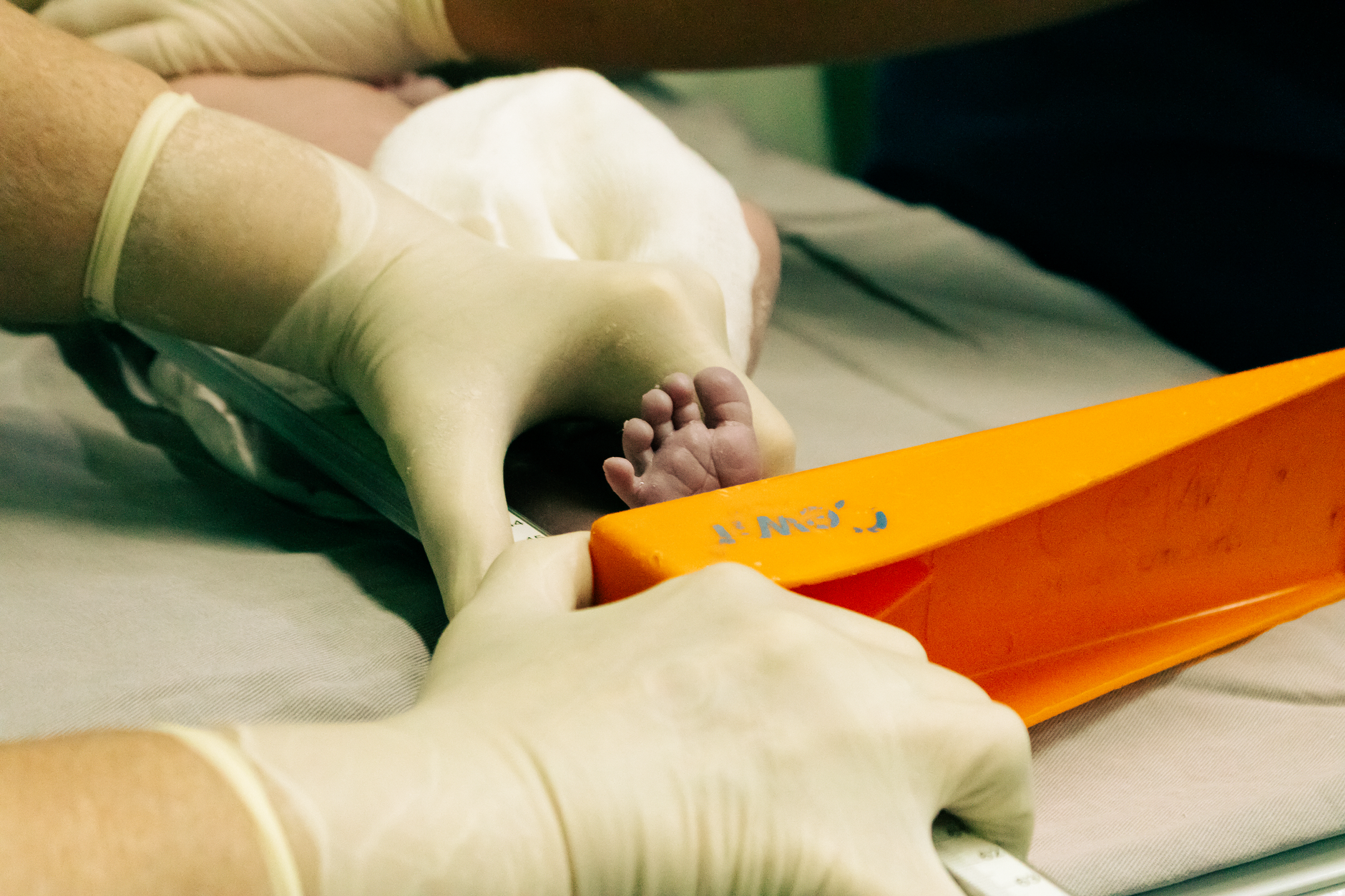
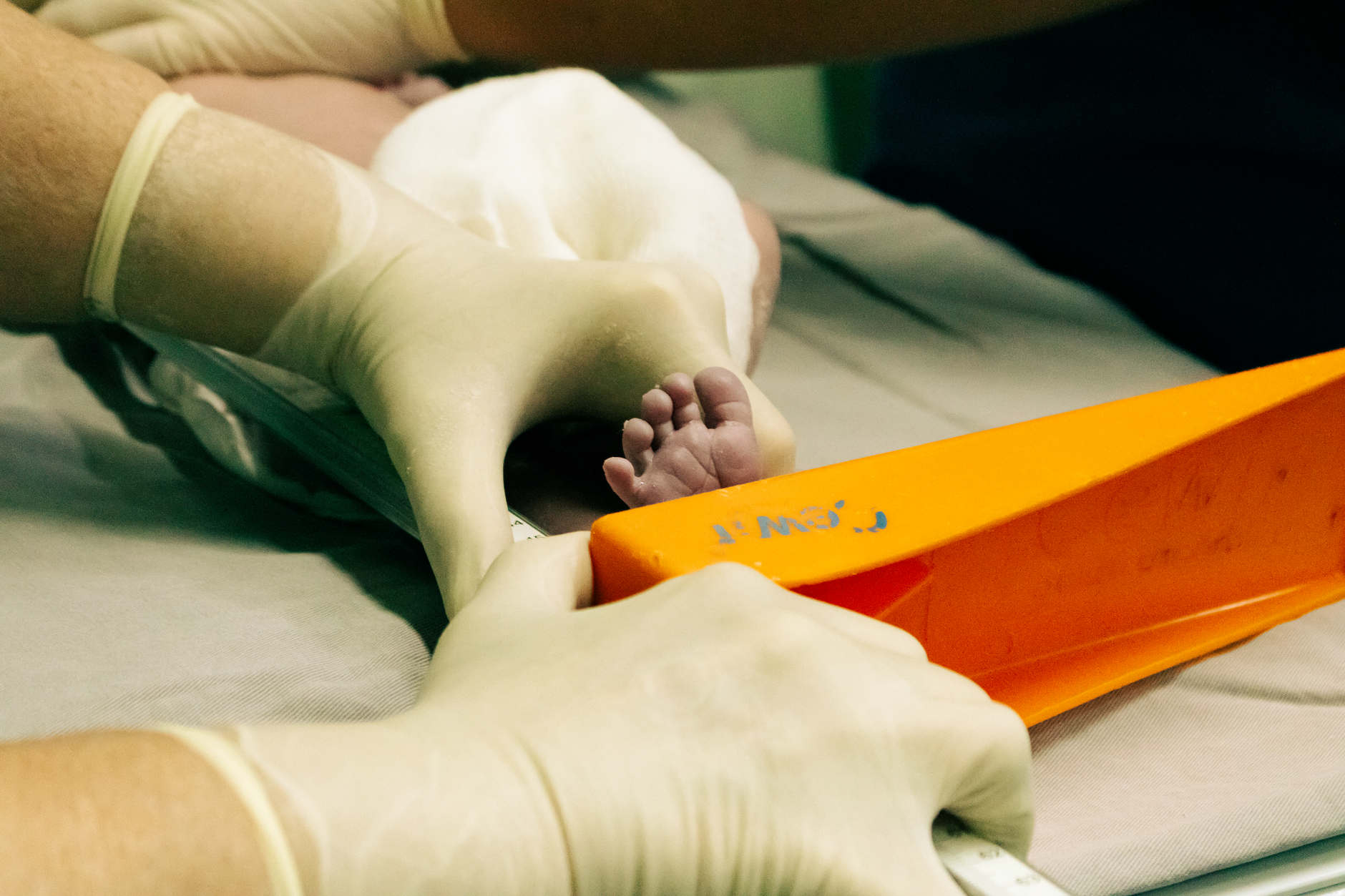
Plantar surface creases: These are the wrinkles on the bottom of the baby’s foot. Very early babies have smooth soles. As they mature, creases start to appear at the toes and gradually move toward the heel. By term, the entire sole is covered in deep creases.
Breast tissue: The size of the breast bud (the little bump under the nipple) grows steadily during pregnancy. A preterm baby may have almost no breast tissue, while a term baby will have a bud about 5–10 millimeters across.
Ear cartilage: The shape and firmness of the ear change as the baby grows. Very preterm babies have soft, floppy ears that stay folded when bent. As cartilage develops, the ear becomes firmer and springs back when bent. By term, the ear is well-formed and holds its shape.
Genitalia: In boys, the testicles descend into the scrotum and the scrotal skin develops more wrinkles as pregnancy progresses. In girls, the labia majora (the outer lips) grow to cover the labia minora (the inner lips) more completely by term.
Neuromuscular maturity signs
These six signs look at how the baby’s nervous system and muscles have developed. They’re assessed by gently moving the baby’s limbs and observing their posture and reflexes. They include:
Posture: How the baby holds their arms and legs when lying on their back. Very preterm babies lie flat with their limbs extended. As they mature, they start to flex their hips, knees, and elbows, bringing their limbs closer to their body. By term, babies hold a strong, flexed posture.
Square window: This measures how far the baby’s wrist can bend. The examiner gently bends the baby’s hand toward the forearm and measures the angle. Very preterm babies can bend their wrists almost flat (a 90-degree angle), while term babies can only bend about 30 degrees.
Arm recoil: The baby’s arm is extended, then released. How quickly and strongly the arm springs back to a flexed position shows muscle tone. Preterm babies have little recoil, while term babies snap back quickly.
Popliteal angle: This measures how far the baby’s knee can extend. The examiner gently straightens the baby’s leg at the knee. Very preterm babies can straighten their legs almost flat, while term babies can only straighten about 90 degrees.
Scarf sign: The baby’s arm is gently pulled across their chest. How far the elbow can reach across the body shows muscle tone. Preterm babies can pull their elbow all the way across, while term babies can only reach about halfway.
Heel to ear: The baby’s foot is gently moved toward their ear. How close the foot can get shows flexibility. Very preterm babies can touch their heel to their ear, while term babies can only reach about halfway up their chest.
Each of these 12 signs is given a point value based on how mature the baby appears. For example, a baby with very smooth soles (no creases) might score 0 for plantar creases, while a baby with deep creases all over the foot might score 4. The points for all 12 signs are added together to give a total score, which can range from –10 to 50.
That total score is then matched to a gestational age using the New Ballard score chart. For example, a total score of 25 corresponds to about 32 weeks, while a score of 40 corresponds to about 40 weeks. The chart is divided into half-week increments, so the score can give a very precise estimate.
If you’d like to see how the scoring works in practice, you can try our New Ballard Score calculator. It walks you through each sign and gives you an estimated gestational age based on the points you enter.
The plantar creases on the bottom of the foot are one of the key physical signs in the New Ballard score—smoother soles suggest an earlier gestational age.
Interpreting the New Ballard score results
Once the exam is done and the points are tallied, the total score is matched to a gestational age on the New Ballard score chart. But what do those numbers actually mean for your baby?
First, it’s important to understand that the score gives an estimate, not an exact age. Most babies fall within 1–2 weeks of their true gestational age, but there’s always some wiggle room. For example, if the score suggests 34 weeks, your baby could actually be anywhere from 32 to 36 weeks. That’s why the score is usually used alongside other information, like prenatal ultrasounds, the mother’s last menstrual period, and the baby’s size and behavior after birth.
Here’s a general guide to what the scores mean:
Total Ballard Score
Estimated Gestational Age
What It Means
–10 to 5
20–24 weeks
Extremely preterm. These babies are born at the very edge of viability and often need intensive medical support.
6 to 15
25–28 weeks
Very preterm. These babies usually need help with breathing, feeding, and temperature control.
16 to 25
29–32 weeks
Moderately preterm. These babies may still need some support, but many can breathe and feed on their own with time.
26 to 35
33–36 weeks
Late preterm. These babies often look like smaller term babies but may still need help with feeding and staying warm.
36 to 45
37–40 weeks
Term. These babies are fully developed and ready for life outside the womb.
46 to 50
41–44 weeks
Post-term. These babies may be larger and have dry, peeling skin from spending extra time in the womb.
One mom, Sarah, shared her experience with us: “My daughter was born at what we thought was 35 weeks, but her Ballard score came back at 33 weeks. It was a shock at first, but it helped the NICU team know exactly what kind of support she’d need. They watched her feeding closely and made sure she stayed warm. Without that score, we might have missed some of the subtle signs that she wasn’t quite as mature as we thought.”
The score isn’t just a number—it’s a roadmap for care. A baby born at 34 weeks will have different needs than one born at 38 weeks, even if they look similar in size. The Ballard score helps the medical team tailor everything from feeding plans to breathing support to developmental follow-up.
What if the score doesn’t match the due date?
It’s not uncommon for the Ballard score to differ from the due date based on the mother’s last menstrual period or prenatal ultrasounds. When that happens, the medical team weighs all the information together. For example:
If the due date was based on a first-trimester ultrasound (which is very accurate), the team may trust that date more than the Ballard score.
If the due date was based on the mother’s memory of her last period (which can be less reliable), the Ballard score may carry more weight.
If the baby is small or large for their gestational age, the team may adjust the estimated age to better match the baby’s size and development.
The goal isn’t to pick one number over another, but to get the most accurate picture possible. That’s why the Ballard score is usually just one piece of the puzzle.
How accurate is the New Ballard score?
The New Ballard score is one of the most reliable tools we have for estimating gestational age after birth, but like all clinical tools, it has its limits. Here’s what the research says about its accuracy:
Within 1–2 weeks: Most studies show that the New Ballard score estimates gestational age within 1–2 weeks of the true age in about 80–90% of babies. That means if your baby’s true age is 34 weeks, the score will likely fall somewhere between 32 and 36 weeks.
More accurate for preterm babies: The score tends to be most reliable for babies born before 37 weeks. For term and post-term babies, other methods (like prenatal ultrasounds) are often more accurate.
Less accurate for very early or very late babies: The score is less precise for babies born before 26 weeks or after 42 weeks. In these cases, the team may rely more on other signs, like the baby’s size and behavior.
Observer variability: Like any exam, the Ballard score can vary slightly depending on who does it. That’s why hospitals train their staff carefully and often have two people double-check the score if there’s any doubt.
One large study published in Pediatrics looked at over 1,000 babies and found that the New Ballard score was accurate within 1 week in 75% of cases and within 2 weeks in 95% of cases. The study also found that the score was just as accurate for babies of different races and ethnicities, which is important for ensuring it works well for all families.
It’s also worth noting that the score is more accurate when it’s done in the first 12–24 hours after birth. After that, some of the signs (like skin texture and posture) can change as the baby adjusts to life outside the womb. That’s why the exam is usually done soon after delivery.
Factors that can affect accuracy
While the New Ballard score is generally reliable, a few things can make it less accurate:
Illness or stress: Babies who are very sick or under stress (like those with infections or breathing problems) may have muscle tone or reflexes that don’t reflect their true gestational age.
Medications: Some medications given to the mother during labor (like magnesium sulfate) can temporarily affect the baby’s muscle tone, making the score less reliable.
Growth issues: Babies who are very small or very large for their gestational age may score differently than expected. For example, a baby who is small because of poor growth in the womb might score as more mature than they really are.
Timing of the exam: The score is most accurate when done in the first day after birth. After that, some signs (like skin texture) can change, making the estimate less precise.
Because of these factors, the medical team will always look at the Ballard score alongside other information, like the mother’s prenatal history, the baby’s size, and how the baby is doing after birth. The score is a tool, not a final verdict.
Clinical applications and limitations of the New Ballard score
The New Ballard score isn’t just an academic exercise—it has real-world applications that can shape your baby’s care in the first hours, days, and even weeks of life. Here’s how it’s used in practice, and where it has its limits.
How the score guides care
Once the Ballard score is done, the medical team uses it to make important decisions about your baby’s care. Here are some of the key ways it’s applied:
Feeding plans: Babies born before 34 weeks often have trouble coordinating sucking, swallowing, and breathing. The Ballard score helps the team decide whether the baby needs a feeding tube, IV nutrition, or can try breastfeeding or bottle-feeding. For example, a baby with a score suggesting 32 weeks may start with small, frequent tube feedings, while a baby scoring 36 weeks might be ready to try breastfeeding right away.
Breathing support: Preterm babies are at higher risk for breathing problems because their lungs aren’t fully developed. The Ballard score helps the team predict whether the baby might need help with breathing, like oxygen, a CPAP machine, or even a ventilator. A baby scoring 28 weeks will likely need more support than one scoring 34 weeks.
Temperature control: Preterm babies have a harder time staying warm because they have less body fat and a larger surface area relative to their size. The Ballard score helps the team decide whether the baby needs to stay in an incubator or can be swaddled and held skin-to-skin. A baby scoring 30 weeks may need an incubator for a few days, while a baby scoring 35 weeks might do fine in a bassinet with a hat and blanket.
Infection risk: Preterm babies are more vulnerable to infections because their immune systems aren’t fully developed. The Ballard score helps the team decide whether to start antibiotics or other treatments if the baby shows signs of infection. A baby scoring 28 weeks may get antibiotics more quickly than a baby scoring 36 weeks.
Developmental follow-up: Babies born preterm are at higher risk for developmental delays, like trouble with movement, speech, or learning. The Ballard score helps the team plan the right follow-up care, like physical therapy, early intervention services, or regular check-ups with a developmental specialist. A baby scoring 30 weeks may need more frequent follow-up than a baby scoring 36 weeks.
Discharge planning: The Ballard score helps the team decide when the baby is ready to go home. They’ll look at whether the baby can breathe, feed, and stay warm on their own, as well as whether any medical issues have been resolved. A baby scoring 34 weeks may need to stay in the hospital for a few extra days or weeks, while a baby scoring 37 weeks might be ready to go home with their parents.
One NICU nurse told us, “The Ballard score is like a cheat sheet for what to expect. It doesn’t tell us everything, but it gives us a starting point. If a baby scores 32 weeks, we know to watch their breathing closely, check their blood sugar often, and start small feedings. If they score 36 weeks, we might focus more on helping them breastfeed and making sure they’re gaining weight.”
Limitations of the New Ballard score
While the New Ballard score is a valuable tool, it’s not perfect. Here are some of its key limitations:
Not a substitute for prenatal care: The score is most useful when the due date isn’t known, but it’s not as accurate as a first-trimester ultrasound. If you had regular prenatal care with early ultrasounds, the team will likely rely more on those dates than the Ballard score.
Observer variability: The score depends on the examiner’s judgment, and different people may score the same baby slightly differently. That’s why hospitals train their staff carefully and often have two people double-check the score if there’s any doubt.
Less accurate for very early or very late babies: The score is less precise for babies born before 26 weeks or after 42 weeks. In these cases, the team may rely more on other signs, like the baby’s size and behavior.
Can be affected by illness or medications: Babies who are very sick or whose mothers received certain medications during labor may score differently than expected. For example, magnesium sulfate (given to prevent preterm labor) can temporarily relax the baby’s muscles, making the score less reliable.
Doesn’t predict long-term outcomes: The Ballard score estimates gestational age, but it doesn’t tell you how your baby will do in the long run. Some preterm babies catch up quickly, while others may need extra support for years. The score is just one piece of the puzzle.
Cultural and individual differences: While the score is designed to work for all babies, there can be subtle differences in how babies from different backgrounds develop. For example, some studies suggest that babies of certain ethnicities may have slightly different skin textures or muscle tone, which could affect the score. However, research shows that the score is generally accurate across different races and ethnicities.
Because of these limitations, the medical team will always use the Ballard score alongside other information, like the mother’s prenatal history, the baby’s size, and how the baby is doing after birth. The score is a tool, not a crystal ball.
New Ballard score vs. other gestational age assessment methods
The New Ballard score is just one of several tools used to estimate a baby’s gestational age. Each method has its strengths and weaknesses, and the medical team will often use a combination of them to get the most accurate picture. Here’s how the Ballard score compares to other common methods:
Method
How It Works
Pros
Cons
Best For
New Ballard score
Assesses 12 physical and neurological signs after birth to estimate gestational age.
Non-invasive, quick, doesn’t require special equipment, works for all babies (20–44 weeks).
Less accurate for very early or very late babies, can vary by examiner, affected by illness or medications.
Babies with uncertain due dates, preterm babies, NICU admissions.
Prenatal ultrasound
Uses sound waves to measure the baby’s size and development during pregnancy.
Very accurate (especially in the first trimester), non-invasive, can detect other issues (like birth defects).
Less accurate later in pregnancy, requires trained technician and equipment, not always available.
All pregnancies, especially those with regular prenatal care.
Last menstrual period (LMP)
Estimates gestational age based on the first day of the mother’s last menstrual period.
Simple, no equipment needed, works for all pregnancies.
Less accurate if cycles are irregular, mother doesn’t remember the date, or ovulation was delayed.
Pregnancies with regular cycles and known LMP.
Dubowitz score
An older version of the Ballard score that assesses 10 neurological and 11 external signs.
Similar to Ballard score, works for a wide range of gestational ages.
More time-consuming, less commonly used today, can be affected by illness or medications.
Historical use; largely replaced by the New Ballard score.
Fetal biometry
Measures the baby’s head, abdomen, and femur length during an ultrasound to estimate size and age.
Accurate in the second trimester, can detect growth issues.
Less accurate later in pregnancy, requires ultrasound equipment and trained technician.
Pregnancies with growth concerns or uncertain due dates.
Postnatal growth charts
Compares the baby’s weight, length, and head circumference to standard growth charts.
Not as accurate for estimating gestational age, affected by genetics and nutrition.
Assessing size and growth after birth, not gestational age.
Which method is most accurate?
The most accurate method depends on when and how it’s used:
First-trimester ultrasound: This is the gold standard for estimating gestational age. It’s accurate within 3–5 days and is the most reliable method when done early in pregnancy.
New Ballard score: This is the best option when the due date isn’t known or when the baby is born preterm. It’s accurate within 1–2 weeks and doesn’t require any special equipment.
Last menstrual period (LMP): This is a simple and widely used method, but it’s less accurate than ultrasound or the Ballard score, especially if the mother’s cycles are irregular.
Other methods: Tools like the Dubowitz score or fetal biometry are useful in specific situations, but they’re not as accurate or widely used as the Ballard score or first-trimester ultrasound.
In practice, the medical team will often use a combination of methods. For example, if a baby is born preterm and the due date from the first-trimester ultrasound is uncertain, the team might use the Ballard score alongside the ultrasound measurements to get the most accurate estimate.
Why the New Ballard score is still widely used
Even though first-trimester ultrasounds are more accurate, the New Ballard score is still a go-to tool in many hospitals. Here’s why:
It works when other methods don’t: Not all pregnancies have early ultrasounds, and not all mothers remember their last menstrual period. The Ballard score can be done after birth, no matter what happened during pregnancy.
It’s quick and easy: The exam takes just 5–10 minutes and doesn’t require any special equipment. That makes it ideal for busy delivery rooms and NICUs.
It’s non-invasive: The exam is gentle and doesn’t cause any discomfort to the baby. That’s important for preterm or sick babies who may already be under stress.
It’s standardized: The New Ballard score is used worldwide, so doctors and nurses everywhere know how to do it and interpret the results. That makes it a reliable tool no matter where you give birth.
It’s backed by research: The score has been studied extensively and is proven to be accurate for most babies. That gives doctors confidence in using it to guide care.
One neonatologist shared, “I use the Ballard score every day in the NICU. It’s not perfect, but it’s a great starting point. If a baby’s score suggests 30 weeks, I know to watch their breathing closely and check their blood sugar often. If it suggests 36 weeks, I might focus more on helping them breastfeed and making sure they’re gaining weight. It’s one of the first things I do when a new baby arrives.”
Using the New Ballard score for preterm and term babies
The New Ballard score is especially useful for preterm babies, but it’s also helpful for term and even post-term babies when the due date is uncertain. Here’s how it’s used for babies at different stages of development:
Preterm babies (born before 37 weeks)
For preterm babies, the Ballard score is often the most important tool for estimating gestational age. That’s because many preterm births happen unexpectedly, and the due date may not be clear. The score helps the medical team predict what kind of support the baby will need and plan the right care.
Here’s how the score is used for preterm babies at different stages:
Extremely preterm (20–25 weeks): These babies are born at the very edge of viability and often need intensive medical support. The Ballard score helps the team decide whether the baby is likely to survive and what kind of care they’ll need. For example, a baby scoring 23 weeks may need help with breathing, feeding, and temperature control, while a baby scoring 25 weeks might be more stable.
Very preterm (26–28 weeks): These babies usually need help with breathing and feeding, but many can survive with the right care. The Ballard score helps the team predict whether the baby will need a ventilator, CPAP, or just oxygen. It also helps them plan feeding strategies, like starting with small, frequent tube feedings.
Moderately preterm (29–32 weeks): These babies may still need some support, but many can breathe and feed on their own with time. The Ballard score helps the team decide whether the baby needs an incubator, a bassinet, or can be held skin-to-skin. It also helps them plan feeding strategies, like starting with breastfeeding or bottle-feeding.
Late preterm (33–36 weeks): These babies often look like smaller term babies, but they may still need help with feeding and staying warm. The Ballard score helps the team decide whether the baby needs extra monitoring, like frequent temperature checks or blood sugar tests. It also helps them plan feeding strategies, like starting with breastfeeding or bottle-feeding.
One mom of a 32-weeker told us, “The Ballard score was a game-changer for us. We thought our son was 34 weeks, but his score suggested 32 weeks. That helped the NICU team know to watch his breathing closely and start small feedings. Without that score, we might have missed some of the subtle signs that he wasn’t quite as mature as we thought.”
Term babies (37–41 weeks)
For term babies, the Ballard score is less commonly used because the due date is usually known from prenatal ultrasounds or the mother’s last menstrual period. However, it can still be helpful in certain situations, like:
When the due date is uncertain (e.g., the mother didn’t have prenatal care or her cycles were irregular).
When the baby is small or large for their gestational age, and the team wants to double-check the due date.
When the baby shows signs of being more or less mature than expected (e.g., trouble breathing or feeding, unusual muscle tone).
For term babies, the Ballard score is usually just one piece of the puzzle. The team will also look at the baby’s size, behavior, and any other signs that might suggest a different gestational age.
Post-term babies (born after 41 weeks)
For post-term babies, the Ballard score is rarely used because the due date is usually known, and these babies are often larger and more developed than expected. However, it can be helpful in certain situations, like:
When the due date is uncertain (e.g., the mother didn’t have prenatal care or her cycles were irregular).
When the baby is smaller than expected for a post-term baby, and the team wants to double-check the due date.
When the baby shows signs of being less mature than expected (e.g., trouble breathing or feeding, unusual muscle tone).
For post-term babies, the Ballard score is usually just one piece of the puzzle. The team will also look at the baby’s size, behavior, and any other signs that might suggest a different gestational age.
Skin-to-skin contact is often part of the care plan for preterm babies—once the Ballard score helps the team know they’re stable enough for it.
Doctor's note
From our medical team:
The New Ballard score is a trusted tool in neonatal care, but it’s important to remember that it’s just one part of the picture. As a neonatologist, I use it every day to guide decisions about breathing support, feeding plans, and developmental follow-up. But I always combine it with other information, like prenatal ultrasounds, the baby’s size, and how they’re doing after birth.
One of the most common questions parents ask is, “How accurate is this score?” The answer is that it’s accurate within 1–2 weeks for most babies, which is usually enough to guide care. But it’s not perfect, and it’s not a substitute for good prenatal care. If you had regular ultrasounds during pregnancy
🔢 Ready to crunch your numbers? Use our New Ballard Score for a personalized result in seconds.
Not sure about the label on Baby S Gestational Age New Ballard Score Result Interpreter products?
Snap the ingredients list and SafeFilter checks every ingredient for your stage — only 3 free scans this month, then you're locked until reset. Unlimited from $7/mo or $50/yr.
When Shubhra Mishra was expecting her first child in 2016, she was overwhelmed by conflicting food advice — one site said yes, another said never. By the time her second baby arrived in 2019, she realized millions of mothers face the same confusion.
That sparked a five-year journey through clinical nutrition papers, cultural diets, and expert conversations — all leading to BumpBites: a calm, compassionate space where science meets everyday motherhood.
Her long-term vision is to build a global community ensuring safe, supported, and free deliveriesfor every mother — because no woman should face pregnancy alone or uninformed. 🌿
🌍 Stand with mothers, shape safer guidance
Join a small circle of experts who review BumpBites articles so expecting parents everywhere can decide with confidence.