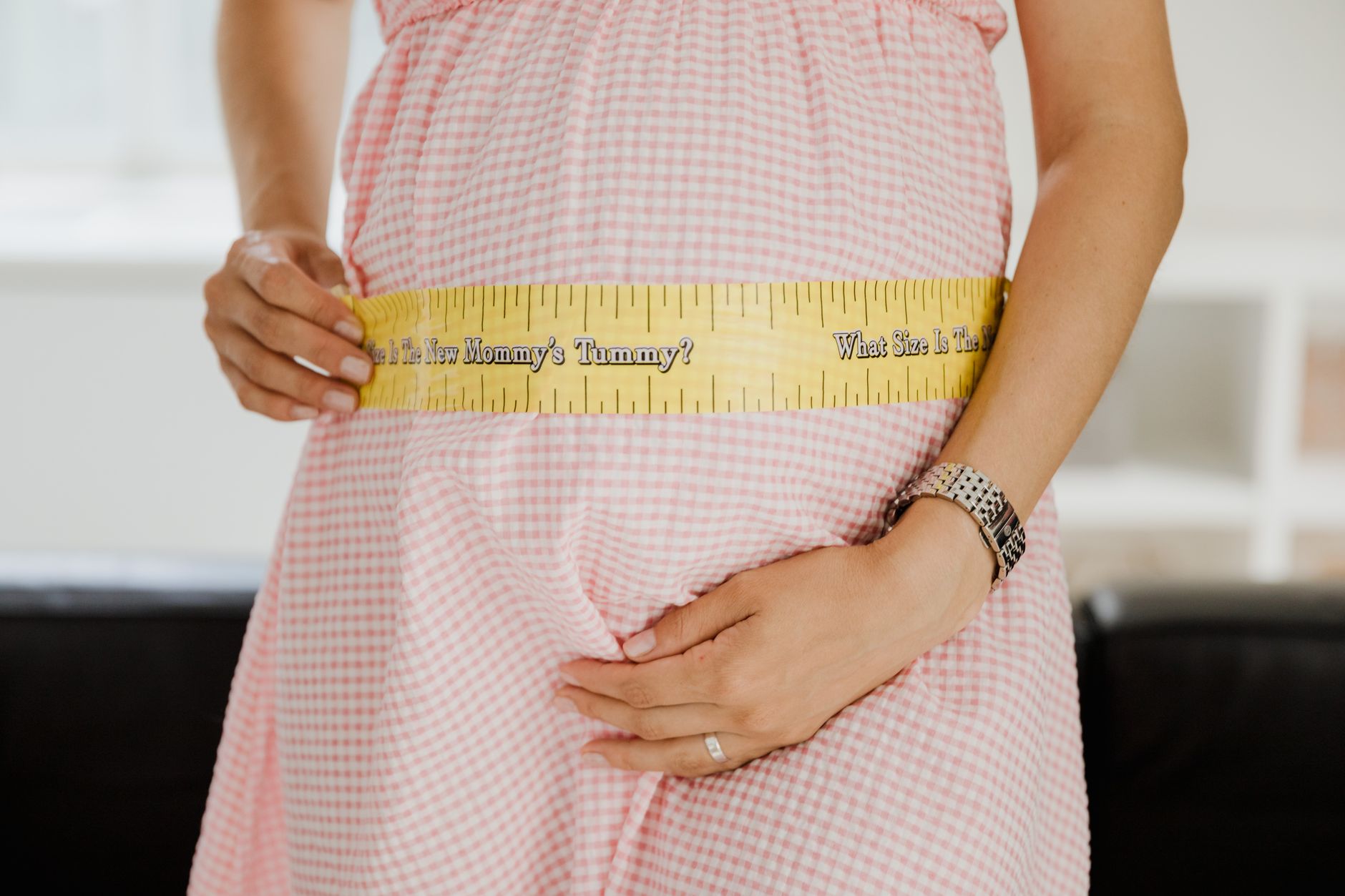
At 42 weeks, a pregnant belly typically measures about 38‑40 inches (96‑102 cm) around the widest point, though size varies with baby position and maternal build.
By Shubhra Mishra — a mom of two who turned her own confusion during pregnancy into BumpBites, a global mission to make food choices clear, safe, and stress-free for every expecting mother. 💛
Check whether any food is safe during pregnancy with the BumpBites Food Safety Checker.
Quick take: At 42 weeks pregnant, your belly size can vary widely—anywhere from 38 to 44 inches around is generally considered normal. Most women measure between 40 and 42 inches, but what matters more than the exact number is whether your belly is growing steadily and your baby is moving well. If your belly feels suddenly much larger or smaller, or if you notice other concerning symptoms (like sharp pain, reduced movement, or leaking fluid), call your provider right away. This article walks you through how to measure, what’s typical, and when to worry.
You’re 42 weeks pregnant. The due date came and went, and your belly—once a source of excitement—now feels like a mystery. Is it too big? Too small? Why does it look different from your friend’s at the same stage? You’re scrolling at 2 a.m., tape measure in hand, wondering if the number on the tape is “normal.”
First, take a breath. Belly size at 42 weeks isn’t a single number—it’s a range, shaped by your baby’s size, position, amniotic fluid, and even how you’re built. What’s “normal” for one woman might look very different for another. The good news? Most post-term bellies fall within a safe range, and your provider is tracking more than just the tape measure to keep you and your baby healthy.
In this guide, we’ll cover exactly how to measure your belly, what the average sizes look like, what affects your belly’s shape and size, and—most importantly—when to call your doctor. You’ll leave knowing what’s typical, what’s not, and how to feel more comfortable in your skin (and your maternity jeans) as you wait for baby to arrive.
Measuring your belly at 42 weeks? Most women measure between 40 and 42 inches, but the number isn’t as important as steady growth and baby’s movement.
What is the average belly size at 42 weeks pregnant?
At 42 weeks pregnant, the average belly measurement—taken around the widest part, usually at the level of your belly button—is about 40 to 42 inches. But here’s the thing: “average” is a wide range. Most women fall between 38 and 44 inches, and anything in that window is generally considered normal. Your provider isn’t just looking at the number on the tape; they’re tracking how your belly has grown over time and how your baby is doing.
One reader, Sarah, shared her experience: “At my 42-week appointment, my belly measured 43 inches. I was convinced something was wrong—my friend was only 39 inches at 40 weeks! But my midwife reassured me that my baby was growing steadily, and the extra fluid I had was part of the reason. A week later, I delivered a healthy 8-pound baby.”
What’s more important than the exact measurement is the trend. If your belly has been growing steadily (about 1 cm per week in the third trimester) and your baby is active, the number itself is less concerning. Your provider will also measure your fundal height—the distance from your pubic bone to the top of your uterus—which should be close to the number of weeks you’re pregnant (so around 42 cm at 42 weeks, give or take 2 cm).
Average belly size at 42 weeks: the numbers
Circumference (around the belly): 38–44 inches (most women: 40–42 inches)
Fundal height (pubic bone to top of uterus): 40–44 cm (42 cm is typical)
Baby’s estimated weight: 7–9 pounds (3.2–4.1 kg) on average, but healthy babies can be smaller or larger
At 42 weeks, your belly may look slightly larger and lower than at 40 weeks, but the difference is often subtle.
How much does a 42-week pregnant belly grow each week?
By 42 weeks, your belly isn’t growing as dramatically as it did in the second trimester, but it’s still changing. Most women gain about 1 cm in fundal height per week in the third trimester, so at 42 weeks, you might measure 1–2 cm more than you did at 40 weeks. In terms of circumference, that translates to about 0.5–1 inch per week, though some women don’t see much change at all.
Here’s what’s happening: your baby is still gaining weight (about 0.5 pounds per week in the final weeks), and your amniotic fluid levels may fluctuate. Some women notice their belly “drops” in the last week or two as the baby settles lower into the pelvis, which can make the belly look smaller or wider, depending on your body shape.
One mom, Priya, described it this way: “At 40 weeks, my belly measured 41 inches. By 42 weeks, it was 42.5 inches, but it didn’t feel ‘bigger’—it just felt heavier and lower. My midwife said the baby had dropped, which explained why I could suddenly breathe easier but waddled even more!”
What affects weekly growth at 42 weeks?
Baby’s position: If your baby is head-down (cephalic), your belly may look lower and wider. If they’re breech (bottom-down), your belly might look higher and rounder.
Amniotic fluid: Some women have more fluid at 42 weeks, which can make the belly look larger. Others have less, which can make the belly feel smaller or “tighter.”
Maternal weight gain: If you’ve gained weight in the last few weeks, your belly may look fuller. But remember, weight gain in pregnancy isn’t just fat—it’s also fluid, the placenta, and the baby.
Posture: As your belly grows, your posture changes. You might arch your back more, which can make your belly look bigger. Standing up straight can help you feel (and look) more balanced.
Is a 42-week pregnant belly size of 40 inches normal?
Yes—40 inches is well within the normal range for a 42-week pregnant belly. In fact, it’s right in the middle of the average (38–44 inches). What matters more than the exact number is whether your belly has grown steadily over the past few weeks and whether your baby is active and healthy.
Your provider will also consider other factors, like:
Your fundal height (should be around 42 cm, give or take 2 cm)
Your baby’s movement patterns (you should still feel regular kicks and rolls)
Your amniotic fluid levels (checked via ultrasound if there are concerns)
Your overall health (blood pressure, swelling, etc.)
One reader, Maria, measured 40 inches at 42 weeks and worried her baby was too small. “I was petite, and my belly never looked ‘huge’ like some of my friends’. But my doctor said my baby was growing perfectly, and at birth, she was a healthy 7 pounds 8 ounces. The tape measure doesn’t tell the whole story.”
When 40 inches might be a concern
While 40 inches is normal, there are a few scenarios where your provider might want to take a closer look:
If your belly suddenly stops growing (no change in fundal height for 2+ weeks)
If your baby’s movements slow down or feel different
If you have other symptoms, like severe swelling, headaches, or leaking fluid
If your fundal height is much smaller than expected (e.g., 38 cm at 42 weeks)
If any of these apply, your provider might order an ultrasound to check your baby’s size and amniotic fluid levels. But in most cases, a 40-inch belly at 42 weeks is nothing to worry about.
What are signs that a 42-week pregnant belly is too large?
A belly that’s larger than expected at 42 weeks isn’t automatically a problem, but it can sometimes signal conditions like polyhydramnios (too much amniotic fluid) or a larger-than-average baby. Here are the signs that your belly might be too large—and when to call your provider:
Red flags to watch for
Your belly measures more than 4 cm larger than expected (e.g., fundal height of 46 cm at 42 weeks). This could indicate excess fluid or a big baby.
Sudden, rapid growth (e.g., your belly jumps from 40 to 44 inches in a week). This could signal fluid buildup.
Severe swelling in your hands, face, or legs, especially if it’s sudden. This could be a sign of pre-eclampsia.
Difficulty breathing or heartburn that’s much worse than usual. A very large belly can press on your diaphragm and stomach.
Leaking fluid or a sudden gush. This could mean your water has broken or you have too much amniotic fluid.
Pain or tightness in your belly that doesn’t go away. This could signal contractions or, rarely, a problem with the placenta.
One mom, Jessica, shared her experience: “At 41 weeks, my belly measured 45 inches, and I could barely see my feet. My doctor ordered an ultrasound and found I had polyhydramnios. They monitored me closely, and I delivered a healthy 9-pound baby a week later. The extra fluid was uncomfortable, but we were both fine.”
What causes a large belly at 42 weeks?
Polyhydramnios: Too much amniotic fluid (affects about 1–2% of pregnancies). It can make your belly look and feel much larger than expected.
Big baby (macrosomia): A baby weighing more than 8 pounds 13 ounces at birth. This is more common if you have gestational diabetes or a family history of large babies.
Multiple babies: If you’re carrying twins or more, your belly will naturally be larger.
Fetal position: If your baby is lying sideways (transverse) or breech, your belly might look wider or higher.
Maternal weight gain: If you’ve gained more weight than expected, some of it may show in your belly.
When to call your doctor
Call your provider right away if you notice:
Your belly measures more than 4 cm larger than expected (e.g., fundal height of 46+ cm at 42 weeks)
Sudden swelling in your hands, face, or legs
Severe pain or tightness in your belly
Leaking fluid or bleeding
Reduced fetal movement
How to measure belly size at 42 weeks pregnant
Measuring your belly at home can give you a rough idea of your size, but it’s not as precise as the measurements your provider takes. That said, if you want to track your growth between appointments, here’s how to do it accurately:
Step-by-step guide to measuring your belly
Gather your tools: You’ll need a soft tape measure (the kind used for sewing) and a helper if possible. It’s hard to measure accurately on your own!
Empty your bladder: A full bladder can make your belly look larger than it is.
Stand up straight: Stand with your feet together and your back against a wall (or just stand naturally). Don’t suck in your belly—relax!
Find the widest part: This is usually around your belly button, but it can vary. Some women measure slightly above or below.
Wrap the tape measure: Hold one end of the tape at the front of your belly and wrap it around to meet at the back. The tape should be snug but not tight—you should be able to slide a finger underneath.
Read the number: Note the measurement where the tape meets. This is your belly circumference.
Measure fundal height (optional): To measure fundal height, find your pubic bone (the hard bone at the front of your pelvis) and the top of your uterus (usually the highest point of your belly). Measure the distance between the two in centimeters. At 42 weeks, this should be around 42 cm, give or take 2 cm.
Tips for accurate measurements
Measure at the same time of day: Your belly size can fluctuate slightly depending on how much you’ve eaten or drunk. Try to measure at the same time each day (e.g., first thing in the morning).
Wear the same clothes: Thick fabrics or belts can add bulk. Measure in a thin top or just your bra and underwear for consistency.
Don’t obsess over the number: Belly size varies widely, and the tape measure isn’t a perfect tool. What matters more is steady growth and your baby’s well-being.
Compare to your provider’s measurements: Your provider’s measurements are more accurate because they’re trained to find the right landmarks. Use your at-home measurements as a rough guide, not a diagnosis.
Measuring your belly at home? Use a soft tape measure, stand up straight, and measure around the widest part (usually at your belly button).
Difference between belly size at 42 weeks and full term
At 42 weeks, your belly might look and feel slightly different than it did at 40 weeks (full term), but the changes are often subtle. Here’s what to expect:
Belly size: 40 weeks vs. 42 weeks
Factor
40 Weeks (Full Term)
42 Weeks (Post-Term)
Average circumference
38–42 inches
40–44 inches
Fundal height
38–42 cm
40–44 cm
Baby’s position
Often engaged (head down in pelvis)
May be engaged or still high (especially if first baby)
Amniotic fluid
Normal levels (500–1000 mL)
May be slightly lower (oligohydramnios) or higher (polyhydramnios)
Belly shape
Often lower and wider as baby drops
May look slightly larger or more stretched; some women report a “tighter” feeling
Discomfort
Pelvic pressure, back pain, Braxton Hicks
Increased pelvic pressure, more frequent Braxton Hicks, possible swelling
Why the difference?
Baby’s growth: Your baby is still gaining weight in the final weeks (about 0.5 pounds per week), which can make your belly look slightly larger.
Amniotic fluid changes: Some women have less fluid at 42 weeks (oligohydramnios), which can make the belly feel smaller or tighter. Others have more fluid (polyhydramnios), which can make the belly look larger.
Baby’s position: At 40 weeks, many babies have “dropped” into the pelvis, making the belly look lower. At 42 weeks, some babies are still high, especially if it’s your first pregnancy.
Posture: As your belly grows, your posture may change. You might arch your back more, which can make your belly look bigger.
One mom, Lisa, shared: “At 40 weeks, my belly measured 41 inches and felt low and heavy. By 42 weeks, it was 43 inches, but it didn’t feel ‘bigger’—just more stretched and uncomfortable. My doctor said the baby had grown a little more, and the extra fluid I had made it look larger. I delivered a healthy 8-pound baby the next day.”
Does baby position affect 42-week pregnant belly size?
Absolutely. Your baby’s position can change how your belly looks and feels at 42 weeks. Here’s how:
How baby position influences belly size
Head-down (cephalic):
Most common position at 42 weeks (about 95% of babies).
If your baby is engaged (head deep in your pelvis), your belly may look lower and wider. You might notice your belly button popping out more, and you may feel more pressure in your pelvis.
If your baby is head-down but not engaged, your belly might look higher and rounder.
Breech (bottom-down):
About 3–4% of babies are breech at term. At 42 weeks, the percentage is slightly higher because some babies turn late.
A breech baby can make your belly look higher and rounder, especially if their bottom is up near your ribs. You might feel kicks near your ribs and pressure near your pelvis.
Some breech babies are “frank breech” (bottom down, legs up), which can make the belly look more pointed at the top.
Transverse (sideways):
Rare at 42 weeks (less than 1% of babies), but more common if you’ve had multiple pregnancies or a lot of amniotic fluid.
A transverse baby can make your belly look very wide and low, almost like a “shelf.” You might feel kicks on both sides of your belly.
Oblique (diagonal):
A baby in an oblique position is somewhere between head-down and transverse. Your belly might look lopsided or uneven.
How to tell your baby’s position
While you can’t diagnose your baby’s position at home, there are a few clues:
Where you feel kicks: If you feel kicks near your ribs, your baby might be breech. If you feel them lower down, your baby is likely head-down.
Belly shape: A head-down baby often makes the belly look lower and wider. A breech baby can make it look higher and rounder.
Heartbeat location: Your provider can listen for your baby’s heartbeat. If it’s low in your belly, your baby is likely head-down. If it’s higher up, your baby might be breech.
Ultrasound: The most accurate way to check your baby’s position is with an ultrasound.
One reader, Aisha, noticed her belly looked “lopsided” at 42 weeks. “I felt kicks on my right side and a hard lump on my left. My midwife checked and said my baby was oblique—head down but tilted to the side. She gave me some exercises to encourage the baby to turn, and by my next appointment, the baby was head-down and engaged. I delivered a few days later!”
Can you change your baby’s position?
If your baby is breech or transverse at 42 weeks, your provider might recommend:
External cephalic version (ECV): A procedure where your provider tries to manually turn your baby into a head-down position. It’s about 50% successful and is usually done around 37–38 weeks, but some providers will attempt it at 42 weeks if there are no contraindications.
Positions and exercises: Some women try techniques like the “forward-leaning inversion” or spending time on hands and knees to encourage the baby to turn. There’s limited evidence that these work, but they’re low-risk and might help.
Acupuncture or moxibustion: Some studies suggest these techniques might help turn a breech baby, but the evidence isn’t strong. Always check with your provider before trying alternative therapies.
If your baby remains breech at 42 weeks, your provider will discuss your delivery options. Many breech babies are delivered via C-section, but some providers are comfortable with vaginal breech births in certain cases.
42 weeks pregnant belly measurement chart
Wondering how your belly size compares to others? Here’s a general guide to belly measurements at 42 weeks. Remember, these are averages—your belly size can vary based on your body shape, baby’s position, and other factors.
Measurement
Average Range at 42 Weeks
What It Might Mean
Fundal height (pubic bone to top of uterus)
40–44 cm
40–44 cm: Normal range. Your baby is growing steadily.
Less than 40 cm: Could indicate a smaller baby, low amniotic fluid, or a baby that’s engaged deep in the pelvis. Your provider may order an ultrasound.
More than 44 cm: Could indicate a larger baby, excess amniotic fluid, or a baby in a breech or transverse position. Your provider may order an ultrasound.
Belly circumference (around the widest part)
38–44 inches
38–44 inches: Normal range. Most women fall in this window.
Less than 38 inches: Could indicate a smaller baby or low amniotic fluid. Your provider may check your baby’s growth.
More than 44 inches: Could indicate a larger baby, excess amniotic fluid, or a baby in a breech or transverse position. Your provider may monitor you more closely.
Baby’s estimated weight
7–9 pounds (3.2–4.1 kg)
Less than 6 pounds (2.7 kg): Could indicate intrauterine growth restriction (IUGR), where the baby isn’t growing as expected. Your provider may order additional monitoring.
More than 9 pounds (4.1 kg): Could indicate macrosomia (a larger-than-average baby). Your provider may discuss delivery options, especially if you have gestational diabetes.
What the chart doesn’t tell you
While this chart can give you a general idea of what’s typical, it’s not a substitute for your provider’s expertise. Here’s why:
Every body is different: If you’re petite, your belly might measure smaller than average, even if your baby is a healthy size. If you’re taller or have a larger frame, your belly might measure bigger.
Baby’s position matters: A breech or transverse baby can make your belly look larger or smaller than expected.
Amniotic fluid levels vary: Too much or too little fluid can change your belly size.
Your provider tracks more than just size: They’re also monitoring your baby’s movement, your blood pressure, and other signs of well-being.
One mom, Elena, measured 39 inches at 42 weeks and worried her baby was too small. “My doctor said my fundal height was normal, and my baby was growing steadily. She reminded me that I was petite, and my belly size reflected my body shape. My son was born at 6 pounds 12 ounces—small but perfectly healthy.”
Average uterine height at 42 weeks
Your fundal height—the distance from your pubic bone to the top of your uterus—is one of the key measurements your provider uses to track your baby’s growth. At 42 weeks, the average fundal height is about 42 cm, give or take 2 cm. Here’s what you need to know:
What is fundal height?
Fundal height is a simple, non-invasive way to estimate your baby’s size and growth. Your provider measures it at every prenatal visit starting around 20 weeks. Here’s how it works:
You lie on your back (or sit up if that’s more comfortable).
Your provider finds your pubic bone (the hard bone at the front of your pelvis).
They measure from the pubic bone to the top of your uterus (the highest point of your belly) using a tape measure.
The measurement in centimeters should roughly match the number of weeks you’re pregnant (e.g., 42 cm at 42 weeks).
Why fundal height matters at 42 weeks
At 42 weeks, your provider is looking for two things:
Steady growth: Your fundal height should increase by about 1 cm per week in the third trimester. If it stops growing or grows too quickly, your provider may order an ultrasound to check your baby’s size and amniotic fluid levels.
Consistency with your baby’s well-being: If your fundal height is much smaller or larger than expected, but your baby is moving well and other signs are normal, your provider may not be concerned. But if there are other red flags (like reduced movement or high blood pressure), they may investigate further.
What if your fundal height is off?
If your fundal height is more than 2 cm smaller or larger than expected (e.g., 38 cm or 46 cm at 42 weeks), your provider may:
Order an ultrasound to check your baby’s size, position, and amniotic fluid levels.
Monitor your baby’s heart rate and movement more closely.
Check for signs of pre-eclampsia (high blood pressure, swelling, protein in your urine) or gestational diabetes (which can lead to a larger baby).
Recommend additional prenatal visits to track your baby’s growth.
One reader, Maya, had a fundal height of 45 cm at 42 weeks. “I was terrified—my friend’s belly measured 41 cm at 40 weeks! But my doctor said my baby was just big, and the extra fluid I had made my belly look larger. They monitored me closely, and I delivered a healthy 9-pound baby a few days later.”
Factors that can affect fundal height
Baby’s position: A breech or transverse baby can make your fundal height look larger or smaller than expected.
Amniotic fluid levels: Too much fluid (polyhydramnios) can make your fundal height larger. Too little fluid (oligohydramnios) can make it smaller.
Maternal weight and body shape: If you have a lot of abdominal fat or a short torso, your fundal height might measure smaller. If you’re tall or have a long torso, it might measure larger.
Multiple babies: If you’re carrying twins or more, your fundal height will be larger than average.
Full bladder or uterus: A full bladder can make your fundal height look larger. A full uterus (from a big baby or excess fluid) can also make it larger.
When to worry about large belly at 42 weeks
A large belly at 42 weeks isn’t automatically a cause for concern, but it can sometimes signal underlying issues. Here’s when to call your provider—and what they might do:
Red flags to watch for
Call your provider right away if you notice any of the following:
Your belly measures more than 4 cm larger than expected (e.g., fundal height of 46+ cm at 42 weeks). This could indicate excess amniotic fluid or a larger-than-average baby.
Sudden, rapid growth (e.g., your belly jumps from 40 to 44 inches in a week). This could signal fluid buildup or other complications.
Severe swelling in your hands, face, or legs, especially if it’s sudden. This could be a sign of pre-eclampsia, a serious pregnancy complication.
Difficulty breathing or heartburn that’s much worse than usual. A very large belly can press on your diaphragm and stomach.
Leaking fluid or a sudden gush. This could mean your water has broken or you have too much amniotic fluid.
Pain or tightness in your belly that doesn’t go away. This could signal contractions or, rarely, a problem with the placenta.
Reduced fetal movement. If your baby isn’t moving as much as usual, call your provider immediately.
Not sure about the label on 42 Weeks Pregnant Belly Size products?
Snap the ingredients list and SafeFilter checks every ingredient for your stage — only 3 free scans this month, then you're locked until reset. Unlimited from $7/mo or $50/yr.
When Shubhra Mishra was expecting her first child in 2016, she was overwhelmed by conflicting food advice — one site said yes, another said never. By the time her second baby arrived in 2019, she realized millions of mothers face the same confusion.
That sparked a five-year journey through clinical nutrition papers, cultural diets, and expert conversations — all leading to BumpBites: a calm, compassionate space where science meets everyday motherhood.
Her long-term vision is to build a global community ensuring safe, supported, and free deliveriesfor every mother — because no woman should face pregnancy alone or uninformed. 🌿
🌍 Stand with mothers, shape safer guidance
Join a small circle of experts who review BumpBites articles so expecting parents everywhere can decide with confidence.