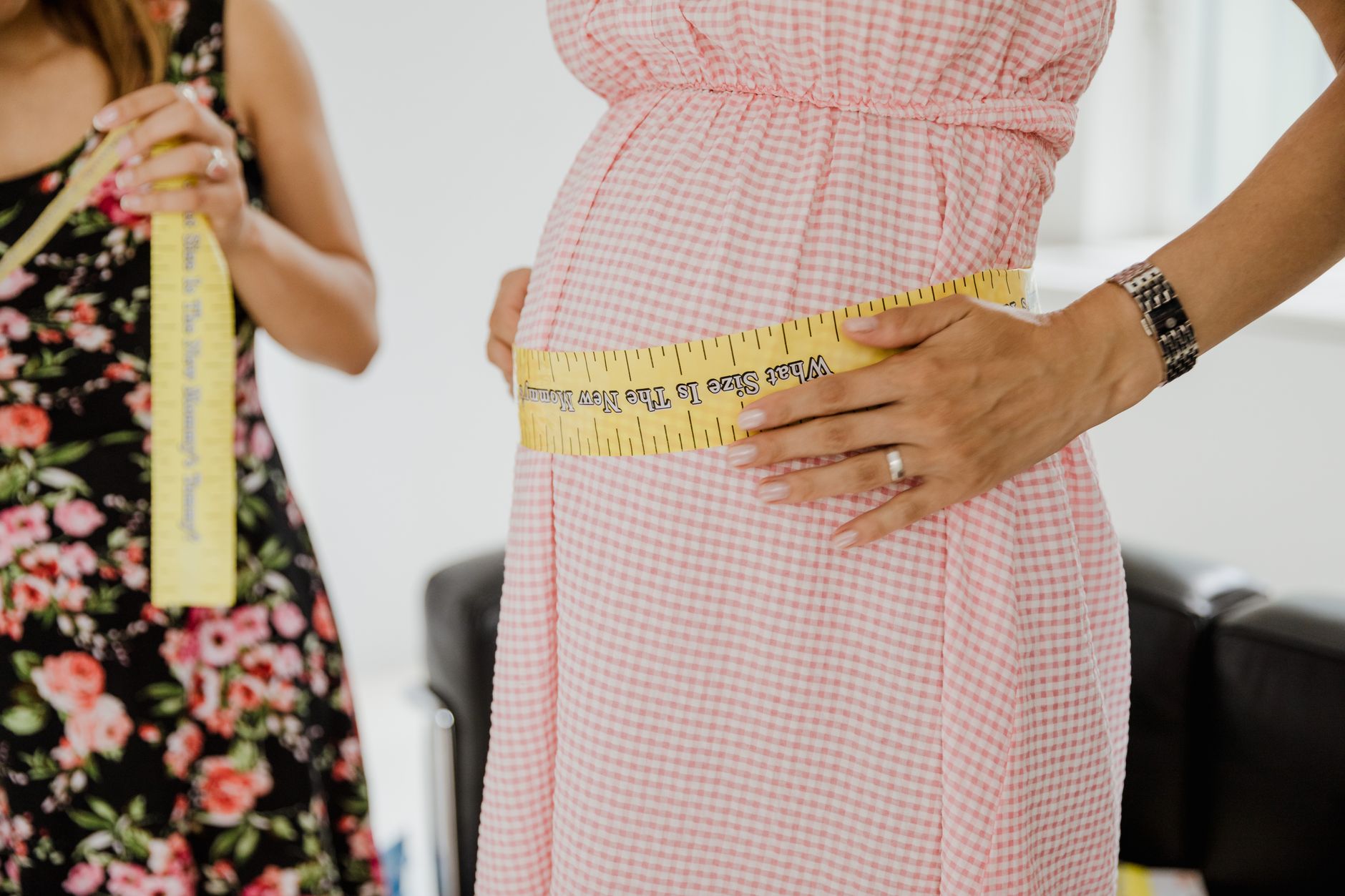
At 30 weeks pregnant, your belly size varies based on factors like baby’s position, body type, and amniotic fluid. Learn what’s typical and when to consult your doctor.
By Shubhra Mishra — a mom of two who turned her own confusion during pregnancy into BumpBites, a global mission to make food choices clear, safe, and stress-free for every expecting mother. 💛
Check whether any food is safe during pregnancy with the BumpBites Food Safety Checker.
Quick take: At 30 weeks pregnant, the average belly measures about 30–34 cm (12–13.5 inches) from the top of your pubic bone to the top of your uterus (fundal height). But your belly size can vary widely—some women measure 28 cm, others 36 cm, and both can be perfectly normal. What matters most isn’t the number on the tape, but whether your baby is growing steadily and you’re feeling well. If you’re worried about your belly size, your provider can check with an ultrasound or fundal height measurement at your next visit.
You’re 30 weeks pregnant, and suddenly, every mirror feels like a measuring tape. You catch your reflection in the bathroom, the kitchen window, even the elevator doors—your belly is front and center, and you can’t help but wonder: Is this normal? One minute you’re comparing yourself to the woman at prenatal yoga whose bump looks twice as big, the next you’re Googling “small belly at 30 weeks” at 2 a.m. because yours doesn’t match the “average” you’ve seen online.
Here’s the truth: there’s no single “right” size for a 30-week belly. Your bump is as unique as your fingerprint—shaped by your body, your baby, and even how you’re carrying. What does matter is whether your little one is growing well and you’re comfortable. In this guide, we’ll walk you through what’s typical, what’s not, and how to tell the difference. You’ll learn how to measure your belly at home, what factors make some bumps bigger or smaller, and when to check in with your provider. No more late-night panic searches—just clear, practical answers.
Your 30-week belly is a sign of your baby’s growth—but it’s not a perfect predictor of size or health.
What Is the Average Belly Size at 30 Weeks Pregnant?
At 30 weeks, most healthcare providers measure your belly from the top of your pubic bone to the top of your uterus—a measurement called fundal height. On average, this distance is about 30 centimeters (or roughly 12 inches). But here’s the thing: “average” is a broad range. Most women measure between 28 and 34 cm at this stage, and all of those numbers can be perfectly normal.
One mom we spoke to, Sarah, remembers her 30-week checkup vividly. “The nurse measured me at 32 cm, and I panicked because my sister was 34 cm at the same stage. I spent the whole night convinced my baby was too small. But at my next ultrasound, everything was fine—my baby was just curled up in a cozy position that made my bump look smaller.”
Fundal height is a quick way for your provider to check that your baby is growing steadily. It’s not an exact science, but it’s a helpful tool—especially when combined with other checks like ultrasounds and your own symptoms. If your measurement is within 2 cm of your weeks pregnant (so 28–32 cm at 30 weeks), your provider will likely tell you everything looks great.
How Many Inches Is a 30-Week Pregnant Belly?
If you’re measuring in inches, a 30-week belly typically falls between 11 and 13.5 inches from your pubic bone to the top of your uterus. But remember, this is just one way to measure. Some women prefer to track their waist circumference—the distance around the fullest part of their belly. At 30 weeks, the average waist circumference is about 40–44 inches, but again, this varies widely.
Here’s a quick reference table to help you visualize the ranges:
Measurement Type
Average at 30 Weeks
Normal Range
Fundal height (pubic bone to top of uterus)
30 cm (12 in)
28–34 cm (11–13.5 in)
Waist circumference (around belly)
42 in
40–44 in
Clothing size increase (from pre-pregnancy)
2–3 sizes
1–4 sizes
Why the range? Your belly size at 30 weeks isn’t just about your baby’s growth—it’s also influenced by your body shape, how much amniotic fluid you have, and even how you’re carrying. A woman with a shorter torso might show earlier and measure larger, while a taller woman might carry her baby more “inside” and measure smaller. Neither is better or worse—it’s just how your body is built.
Measuring your belly at home? Use a soft tape measure and keep it snug but not tight.
30 Weeks Pregnant Belly Size vs. Baby Growth Chart
It’s tempting to think that a bigger belly equals a bigger baby, but the two don’t always line up. Your belly size at 30 weeks is influenced by many factors beyond just your baby’s weight. Here’s how they compare:
Baby’s size at 30 weeks: On average, your baby weighs about 3 pounds (1.4 kg) and is roughly 15.7 inches (40 cm) long—about the size of a large cabbage. But babies grow at different rates, and some perfectly healthy babies weigh 2.5 pounds, while others tip the scales at 3.5 pounds.
Belly size: As we’ve seen, fundal height at 30 weeks is typically 28–34 cm. But this measurement includes not just your baby, but also the placenta, amniotic fluid, and your growing uterus. A woman with a lot of amniotic fluid (a condition called polyhydramnios) might have a larger belly, even if her baby is average size. Similarly, a woman with less fluid (oligohydramnios) might have a smaller belly, even if her baby is growing well.
Here’s a simple way to think about it: your belly is like a cozy apartment for your baby. The size of the apartment doesn’t always tell you how big the tenant is—it also depends on how much furniture (placenta, fluid) is inside and how the space is arranged (baby’s position).
One mom, Priya, shared her experience: “At 30 weeks, my belly measured 33 cm, and I was convinced I was having a giant baby. But at my ultrasound, my little one was right on track—just surrounded by a bit more amniotic fluid. My provider explained that fluid levels can fluctuate, and as long as my baby was growing steadily, there was nothing to worry about.”
Is My 30-Week Belly Size Normal for a First Pregnancy?
If this is your first pregnancy, you might notice that your belly looks—or measures—smaller than you expected at 30 weeks. That’s completely normal! First-time moms often “show” later and carry their babies higher because their abdominal muscles are tighter. It’s not uncommon for a first-time belly to measure on the lower end of the normal range (around 28–30 cm) at 30 weeks.
On the flip side, if you’ve been pregnant before, your belly might measure larger at 30 weeks. Your abdominal muscles have already stretched once, so they’re more relaxed, and your uterus might sit lower in your pelvis. Second- (or third-) time moms often measure closer to 32–34 cm at this stage.
Here’s what’s typical for first-time moms at 30 weeks:
Fundal height: 28–32 cm (11–12.5 in)
Waist circumference: 40–43 in
Clothing size: 1–3 sizes larger than pre-pregnancy
How you’re carrying: Often higher and more compact, especially if you have strong core muscles.
If you’re a first-time mom and your belly measures 34 cm at 30 weeks, don’t panic—it doesn’t mean your baby is too big. It might just mean your uterus is sitting a little lower, or you have a bit more amniotic fluid. Your provider will keep an eye on your baby’s growth with ultrasounds and fundal height checks to make sure everything is progressing well.
How to Measure Your Belly at 30 Weeks Pregnant
Want to track your belly size at home? Measuring your fundal height is simple, and it can give you peace of mind between prenatal visits. Here’s how to do it correctly:
Gather your tools: You’ll need a soft tape measure (the kind used for sewing) and a helper. It’s tricky to measure your own belly accurately, so ask your partner, a friend, or even use a mirror to guide you.
Empty your bladder: A full bladder can push your uterus up and skew your measurement. Pee first for the most accurate result.
Lie down comfortably: Lie on your back on a flat surface (like your bed or a yoga mat) with your knees slightly bent. Prop a pillow under your head if it’s more comfortable.
Find your pubic bone: Place your fingers at the top of your pubic bone—it’s the hard, flat bone just above your pubic hair. This is your starting point.
Locate the top of your uterus: Gently press your fingers into your belly and feel for the top of your uterus (called the fundus). It should feel firm and rounded, like a small melon. If you’re not sure, try this trick: place your hands on either side of your belly and press gently inward until you feel resistance—that’s the top of your uterus.
Measure the distance: Have your helper hold the tape measure at your pubic bone and stretch it straight up to the top of your uterus. Keep the tape snug against your skin, but don’t pull it tight. The number where the tape meets the top of your uterus is your fundal height in centimeters.
Record your measurement: Write down the number and the date. You can track your measurements over time to see how your belly is growing. Most women’s fundal height increases by about 1 cm per week after 20 weeks.
Remember, this is just a rough guide. If your measurement is within 2 cm of your weeks pregnant (so 28–32 cm at 30 weeks), it’s likely normal. But if you’re concerned, or if your measurement is consistently outside this range, mention it to your provider at your next visit.
One thing to keep in mind: fundal height measurements can vary based on your baby’s position. If your little one is curled up or facing your spine, your belly might measure smaller. If they’re stretched out or facing your belly button, it might measure larger. That’s why your provider will often combine fundal height checks with ultrasounds to get the full picture.
What Factors Affect Belly Size at 30 Weeks?
Your belly size at 30 weeks isn’t just about your baby’s growth—it’s influenced by a mix of factors, some of which you can control, and some you can’t. Here are the biggest ones:
Your body type and shape: Women with shorter torsos often show earlier and measure larger because there’s less vertical space for the baby to grow. Taller women might carry their babies more “inside” and measure smaller. Your pre-pregnancy weight also plays a role: women with a higher BMI might show later, while women with a lower BMI might show earlier.
Amniotic fluid levels: The amount of fluid surrounding your baby can make your belly look bigger or smaller. Too much fluid (polyhydramnios) can make your belly measure larger, while too little (oligohydramnios) can make it measure smaller. Both conditions are monitored by your provider.
Baby’s position: If your baby is head-down and curled up, your belly might look smaller. If they’re stretched out or breech (bottom-down), it might look larger. Baby’s position can change frequently at this stage, so don’t be surprised if your belly looks different from one day to the next.
Placenta location: If your placenta is attached to the front of your uterus (called an anterior placenta), it can act like a cushion and make your belly look smaller. If it’s attached to the back (posterior placenta), your belly might look more pronounced.
Multiple babies: If you’re carrying twins or triplets, your belly will likely measure larger than average. At 30 weeks with twins, fundal height is often closer to 35–40 cm, and your waist circumference might be 45 inches or more.
Your core muscles: Women with strong abdominal muscles (like athletes or those who do regular core work) might carry their babies higher and measure smaller. Women with weaker core muscles might show earlier and measure larger.
Weight gain during pregnancy: How much weight you’ve gained can affect your belly size, but it’s not the only factor. Some women gain weight mostly in their belly, while others gain it in their hips, thighs, or breasts. Your provider will track your overall weight gain, not just your belly size, to ensure you and your baby are healthy.
One mom, Lisa, shared how her belly size changed with each pregnancy: “With my first baby, I barely showed at 30 weeks—my belly measured 29 cm, and I was convinced something was wrong. But my provider reassured me that my strong core muscles were keeping my baby snug. With my second, I measured 33 cm at 30 weeks, and my belly looked huge! Turns out, my uterus was just more relaxed, and my baby was in a different position. Both babies were born healthy and at a great weight.”
When Should I Be Concerned About a Small or Large Belly at 30 Weeks?
Most of the time, a belly that’s smaller or larger than average at 30 weeks is nothing to worry about. But there are a few signs that could indicate a problem with your baby’s growth or your amniotic fluid levels. Here’s when to check in with your provider:
Signs of a Small Belly (Possible Intrauterine Growth Restriction, or IUGR)
IUGR is a condition where a baby isn’t growing at the expected rate. It affects about 3–7% of pregnancies and can be caused by issues with the placenta, maternal health conditions (like high blood pressure or diabetes), or genetic factors. Signs that your belly might be measuring small for gestational age include:
Your fundal height is more than 2 cm smaller than expected (e.g., less than 28 cm at 30 weeks).
Your belly hasn’t grown in size over 2–3 weeks (your provider will track this at your prenatal visits).
You’re not gaining weight, or you’ve lost weight during pregnancy.
You feel less fetal movement than usual (though this can also be normal—trust your instincts).
Your provider notices that your amniotic fluid levels are low on an ultrasound.
If your provider suspects IUGR, they’ll likely order an ultrasound to measure your baby’s growth and check the blood flow in your placenta. Depending on the results, they might recommend more frequent monitoring, bed rest, or early delivery if your baby isn’t thriving.
Signs of a Large Belly (Possible Macrosomia or Polyhydramnios)
A larger-than-average belly at 30 weeks could mean your baby is growing faster than expected (macrosomia), or that you have too much amniotic fluid (polyhydramnios). Both are relatively rare but worth monitoring. Signs to watch for include:
Your fundal height is more than 2 cm larger than expected (e.g., more than 34 cm at 30 weeks).
Your belly has grown rapidly in a short period (e.g., 4 cm in one week).
You’re gaining weight quickly, especially if it’s concentrated in your belly.
You feel short of breath or have trouble moving comfortably.
Your provider notices that your amniotic fluid levels are high on an ultrasound.
Macrosomia (a baby weighing more than 8 pounds, 13 ounces at birth) can increase the risk of complications during delivery, like shoulder dystocia (when the baby’s shoulders get stuck). Polyhydramnios can increase the risk of preterm labor or placental abruption. If your provider suspects either condition, they’ll monitor you closely with ultrasounds and may recommend early delivery if necessary.
Other Red Flags to Watch For
Regardless of your belly size, call your provider right away if you notice any of these symptoms:
Sudden, severe swelling in your hands, feet, or face (could indicate preeclampsia).
Severe abdominal pain or cramping that doesn’t go away.
Vaginal bleeding or leaking fluid.
A significant decrease in fetal movement (fewer than 10 movements in 2 hours after 28 weeks).
Severe headaches, vision changes, or dizziness (could indicate high blood pressure).
Remember, most of the time, a belly that’s smaller or larger than average is just a variation of normal. But it’s always better to check in with your provider if something feels off. They can reassure you or run tests to make sure everything is okay.
Gentle stretches and good posture can help you stay comfortable as your belly grows.
From our medical team: “We see so many moms fixate on their belly size at 30 weeks, but the truth is, there’s no ‘ideal’ measurement. What matters is the trend over time—is your baby growing steadily? Are you feeling well? Are your amniotic fluid levels normal? If the answer to those questions is yes, then your belly size is just a number. That said, if you’re ever worried, don’t hesitate to reach out. We’d rather you ask and get reassurance than spend weeks stressing at home.”
Myth vs. Fact
Myth: A bigger belly at 30 weeks means you’re having a bigger baby.
Fact: Belly size is influenced by many factors, including amniotic fluid levels, placenta position, and your body shape. A larger belly doesn’t always mean a larger baby, and a smaller belly doesn’t always mean a smaller baby. The only way to know your baby’s size is through an ultrasound.
Myth: If your belly is small at 30 weeks, your baby isn’t growing well.
Fact: Many women with smaller bellies have perfectly healthy babies. What matters is whether your baby is growing steadily over time. Your provider will track this with fundal height measurements and ultrasounds. If there’s a concern, they’ll let you know and take steps to monitor your baby more closely.
Myth: You can tell your baby’s position by the shape of your belly.
Fact: While some women swear they can tell their baby’s position by how their belly looks, it’s not a reliable method. Babies move around a lot, especially at 30 weeks, and their position can change from day to day (or even hour to hour). The only way to know for sure is through an ultrasound or a provider’s hands-on check.
Key Takeaways
At 30 weeks pregnant, the average fundal height is 30 cm (12 inches), but normal measurements range from 28–34 cm (11–13.5 inches).
Your belly size is influenced by factors like your body shape, amniotic fluid levels, baby’s position, and placenta location—not just your baby’s size.
First-time moms often measure smaller at 30 weeks because their abdominal muscles are tighter, while moms who’ve been pregnant before might measure larger.
You can measure your belly at home using a soft tape measure, but remember that fundal height is just one tool your provider uses to check your baby’s growth.
Most of the time, a belly that’s smaller or larger than average is nothing to worry about. But if your fundal height is more than 2 cm off from your weeks pregnant, or if you notice other concerning symptoms, check in with your provider.
Focus on how you’re feeling and your baby’s movement—not just the number on the tape. If something feels off, trust your instincts and call your provider.
Frequently Asked Questions
How many inches should a 30-week pregnant belly be?
At 30 weeks, the average fundal height (from your pubic bone to the top of your uterus) is about 12 inches (30 cm). However, normal measurements range from 11 to 13.5 inches (28–34 cm). Your waist circumference (around the fullest part of your belly) is typically 40–44 inches at this stage.
Is a small belly at 30 weeks a cause for concern?
Not necessarily. A small belly at 30 weeks can be normal, especially if you have a shorter torso, strong core muscles, or an anterior placenta. What matters is whether your baby is growing steadily over time. If your fundal height is more than 2 cm smaller than expected (e.g., less than 28 cm at 30 weeks), your provider may recommend an ultrasound to check your baby’s growth and amniotic fluid levels.
Can I measure my belly size at home?
Yes! You can measure your fundal height at home using a soft tape measure. Lie down, find the top of your pubic bone and the top of your uterus, and measure the distance between them. Keep in mind that this is just a rough guide—your provider’s measurements will be more accurate. If you’re concerned about your belly size, mention it at your next prenatal visit.
What causes a larger belly at 30 weeks?
A larger belly at 30 weeks can be caused by several factors, including:
An anterior placenta, which can make your belly look bigger.
Your body shape—women with shorter torsos often measure larger because there’s less vertical space for the baby to grow.
Does belly size indicate baby’s weight at 30 weeks?
Not reliably. While a larger belly can sometimes mean a larger baby, it’s not a guarantee. Your belly size is influenced by many factors, including amniotic fluid levels, placenta position, and your body shape. The only way to estimate your baby’s weight is through an ultrasound, and even those measurements can be off by up to 10–15%.
When should I talk to my doctor about my belly size?
Call your provider if:
Your fundal height is more than 2 cm smaller or larger than expected (e.g., less than 28 cm or more than 34 cm at 30 weeks).
Your belly hasn’t grown in size over 2–3 weeks.
You notice a sudden, rapid increase in belly size (e.g., 4 cm in one week).
You experience other concerning symptoms, like decreased fetal movement, severe swelling, or abdominal pain.
When to Call Your Doctor
While variations in belly size are usually normal, there are a few red flags that warrant a call to your provider:
Your fundal height is more than 2 cm smaller or larger than your weeks pregnant (e.g., less than 28 cm or more than 34 cm at 30 weeks).
You notice a sudden change in your belly size (e.g., it grows or shrinks rapidly over a few days).
You feel less fetal movement than usual, or your baby’s movements change significantly.
You experience severe abdominal pain, cramping, or contractions.
You have vaginal bleeding, leaking fluid, or signs of preterm labor (like regular contractions or pelvic pressure).
You develop sudden, severe swelling in your hands, feet, or face, or you have a severe headache, vision changes, or dizziness (these could be signs of preeclampsia).
Remember: This article is for informational purposes only and isn’t a substitute for professional medical advice. Always check with your provider if you have concerns about your belly size or your baby’s growth.
References
American College of Obstetricians and Gynecologists (ACOG). (2021). Prenatal Development: How Your Baby Grows During Pregnancy.
National Health Service (NHS). (2023). Your Pregnancy at 28 to 32 Weeks.
Mayo Clinic. (2022). Fundal Height: An Indicator of Fetal Growth.
Cleveland Clinic. (2023). Amniotic Fluid: What’s Normal and What’s Not.
Royal College of Obstetricians and Gynaecologists (RCOG). (2021). Growth Restriction in the Baby.
American Pregnancy Association. (2023). Measuring Fundal Height.
March of Dimes. (2022). Polyhydramnios: Too Much Amniotic Fluid.
Not sure about the label on 30 Weeks Pregnant Belly Size products?
Snap the ingredients list and SafeFilter checks every ingredient for your stage — only 3 free scans this month, then you're locked until reset. Unlimited from $7/mo or $50/yr.
When Shubhra Mishra was expecting her first child in 2016, she was overwhelmed by conflicting food advice — one site said yes, another said never. By the time her second baby arrived in 2019, she realized millions of mothers face the same confusion.
That sparked a five-year journey through clinical nutrition papers, cultural diets, and expert conversations — all leading to BumpBites: a calm, compassionate space where science meets everyday motherhood.
Her long-term vision is to build a global community ensuring safe, supported, and free deliveriesfor every mother — because no woman should face pregnancy alone or uninformed. 🌿
🌍 Stand with mothers, shape safer guidance
Join a small circle of experts who review BumpBites articles so expecting parents everywhere can decide with confidence.