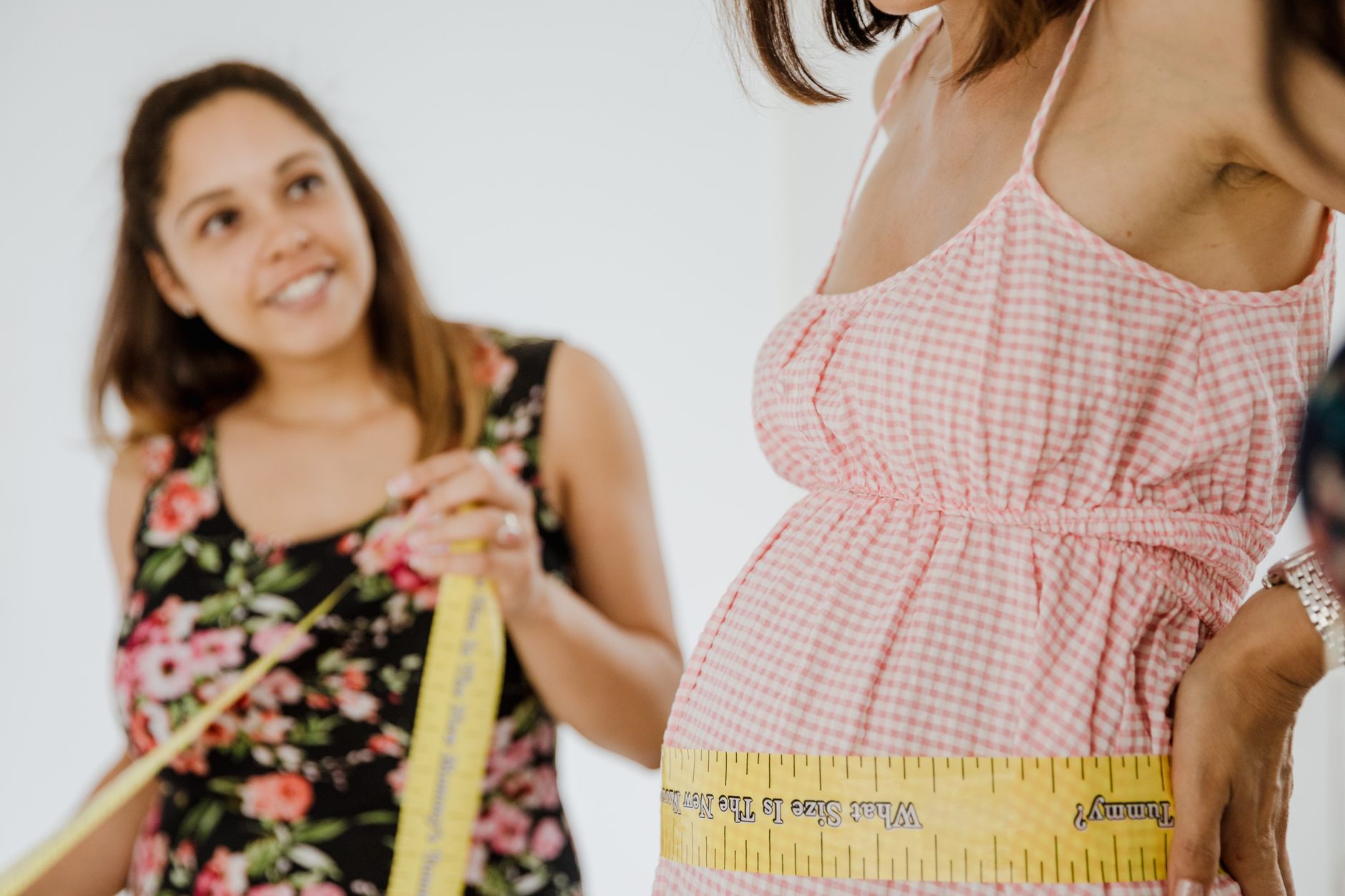
At 25 weeks pregnant, your belly size typically measures 22-27 cm from pubic bone to top. Learn what’s normal, factors affecting growth, and when to consult your doctor.
By Shubhra Mishra — a mom of two who turned her own confusion during pregnancy into BumpBites, a global mission to make food choices clear, safe, and stress-free for every expecting mother. 💛
Check whether any food is safe during pregnancy with the BumpBites Food Safety Checker.
Quick take: At 25 weeks pregnant, most expectant mothers measure a belly circumference of about 15–16 inches (38–41 cm). Growth slows to roughly 0.5 inch (1 cm) per week around this time, and a size of 15 inches is well within the normal range. If your belly feels suddenly much larger, feels unusually tight, or you notice rapid changes, reach out to your provider.
It’s 2 a.m., you’re curled up with a cup of tea, and a friend just texted, “My belly looks huge for 25 weeks—should I be worried?” You stare at the screen, heart racing, and wonder if the size you see is normal or a sign something’s off. You’re not alone. Many parents‑to‑be ask the same question, and the answer is usually reassuring, but it helps to know what “normal” looks like, how to measure accurately, and which factors can change the picture.
In this guide we’ll walk through the average 25‑week belly size, how fast a belly typically grows, how to measure it, what influences its size, and when a change might need a doctor’s eye. We’ll also compare it to the weeks just before and after, give practical clothing tips, and answer the most common follow‑up questions.
What is the average belly size at 25 weeks pregnant?
When clinicians talk about “fundal height,” they’re measuring from the top of the pubic bone to the top of the uterus. Around 25 weeks, the fundal height usually matches the gestational age in centimeters—about 25 cm (≈ 10 inches). Because the belly’s outer circumference includes skin, fat, and the abdominal muscles, the overall belly measurement is typically 4–6 inches larger than the fundal height.
Based on data from the American College of Obstetricians and Gynecologists (ACOG) and the UK's National Health Service (NHS), the average belly circumference at 25 weeks falls between 15 inches (38 cm) and 16 inches (41 cm). First‑time mothers often sit at the lower end of that range, while those who have been pregnant before may measure a bit larger because the abdominal muscles have already been stretched.
It’s also helpful to know the average waist circumference for a pregnant person at this stage. Studies in the Journal of Maternal‑Fetal & Neonatal Medicine report a median waist circumference of about 35 inches (89 cm) at 24‑26 weeks, which aligns with the belly‑circumference numbers above when you add the extra layers of skin and muscle.
In short, if your belly measures around 15–16 inches, you’re right on track.
Measuring your belly each week can help you notice normal growth patterns.
How many inches does a belly grow each week at 25 weeks?
From about week 20 to week 28, the uterus expands rapidly, but the rate of visible abdominal growth begins to plateau. On average, a belly circumference increases by 0.4–0.6 inch (1–1.5 cm) per week around the 25‑week mark.
This slower pace reflects two things: the baby’s head is growing faster than the torso, and the uterus is filling up more space within the abdominal cavity rather than pushing the belly outward. The American Pregnancy Association notes that many mothers notice a “steady but modest” increase in belly size during weeks 24‑26.
Because growth isn’t perfectly linear, you might see a week where the belly doesn’t change at all, followed by a week with a 0.8‑inch jump. Both are normal as long as the overall trend follows the 0.4‑0.6 inch per week average.
Is a 25‑week pregnant belly size of 15 inches normal?
Yes. A 15‑inch (38 cm) belly at 25 weeks sits comfortably within the typical range of 15–16 inches. It’s especially common for first‑time pregnancies, where the abdominal muscles have not yet been stretched by previous pregnancies.
A quick way to confirm is to compare your measurement with your fundal height. If your fundal height is about 25 cm (≈ 10 inches) and your belly circumference is roughly 5–6 inches larger, you’re on track. Many clinicians use this simple rule of thumb during prenatal visits.
That said, individual variation is wide. Factors like maternal body‑mass index (BMI), the amount of amniotic fluid, and even the baby’s position can shift the measurement a little higher or lower. As long as you’re not experiencing pain, severe tightening, or rapid changes, a 15‑inch belly is normal.
How to measure your belly size at 25 weeks pregnancy
Accurate measurement is simple, but a few tips can improve consistency:
Pick a consistent time. Measure in the morning after you’ve emptied your bladder, when the belly is least likely to be bloated.
Use a flexible, non‑stretchable tape. Cloth or plastic measuring tapes work best; avoid elastic bands.
Find the right landmarks. Place the tape around the widest part of your abdomen—usually just above the belly button.
Keep it level. Ensure the tape is snug but not compressing the skin, and that it sits flat against your skin all the way around.
Record the number. Write it down or note it in a pregnancy app. Repeat the measurement weekly to track growth.
Here’s a step‑by‑step guide:
Stand upright with relaxed shoulders.
Wrap the tape around the fullest part of your belly, parallel to the floor.
Pull the tape gently until it meets itself—don’t pull too tight.
Read the measurement at the point where the tape meets the zero mark.
Record the result in inches and centimeters.
If you prefer metric, the same process yields a measurement in centimeters (e.g., 38 cm). Maintaining both units helps if you need to discuss numbers with an international provider.
What factors affect belly size at 25 weeks pregnant?
Several variables can make your belly appear larger—or smaller—than the average:
Factor
How it influences size
Baby’s weight and position
A heavier baby or one that’s low in the pelvis can push the belly outward more.
Amniotic fluid volume
Higher fluid (polyhydramnios) expands the uterus, increasing circumference.
Maternal weight gain
Extra maternal fat adds to belly girth; ACOG recommends 1‑2 lb per week in the second trimester.
Multiple pregnancies
Twins or more add significant volume, often 2‑4 inches larger.
Previous pregnancies
Abdominal muscles may be more relaxed, allowing a slightly larger belly.
Hydration status
Dehydration can make the belly feel tighter, while fluid retention can add a bit of girth.
Maternal BMI
Higher pre‑pregnancy BMI can lead to a larger baseline circumference.
Most of these factors are normal aspects of pregnancy. For example, a baby’s size at 25 weeks typically ranges from 1.2 lb to 1.5 lb (550–680 g). That weight alone contributes only a few millimeters to the overall belly size. In contrast, gaining the recommended 1‑2 lb per week of maternal weight can add up to an inch or more over several weeks.
Dehydration, while not a major driver of size, can cause the uterus to feel tighter, making the belly feel more uncomfortable. Drinking adequate fluids (about 2‑3 L per day) helps maintain a comfortable stretch.
Compare 25‑week belly size to 24 and 26 weeks
Understanding the progression helps you recognize what’s typical. Below is a snapshot of average belly circumference ± standard deviation for weeks 24‑26:
Gestational Week
Average Belly Circumference (inches)
Average Belly Circumference (cm)
24 weeks
14.5 in
37 cm
25 weeks
15.2 in
38.5 cm
26 weeks
15.8 in
40 cm
Notice the gradual increase of about 0.5 inch per week. If you measured 14.8 inches at week 24 and 15.3 inches at week 25, you’re following the expected pattern. Jumping to 16.5 inches at week 25 would be a larger-than‑expected change and worth discussing.
Many mothers share a similar story: “I measured 14 inches at 24 weeks, and by 25 weeks it was 15 inches. I thought something was wrong, but my OB‑GYN said it was just the normal growth curve.” Tracking week‑to‑week helps you see the curve rather than isolated numbers.
When should I be concerned about rapid belly growth at 25 weeks?
Rapid, sudden expansion—especially if accompanied by pain, pressure, or decreased fetal movement—can signal issues such as excessive amniotic fluid (polyhydramnios) or uterine rupture (rare). Here are red‑flag signs to watch for:
Increase of more than 2 inches (5 cm) in a single week.
Severe abdominal pain, cramping, or a feeling of “tightness” that doesn’t ease.
Reduced fetal movements (fewer kicks than usual).
Sudden swelling of the hands, feet, or face (possible pre‑eclampsia).
Bleeding or fluid leaking from the vagina.
If any of these appear, contact your provider promptly. In most cases, a modest increase is simply the baby’s normal growth, but it’s always safest to have a professional check.
Choosing stretchy, breathable clothes can accommodate a growing belly without sacrificing style.
Additional considerations for a 25‑week belly
Beyond the core questions, many parents wonder about related topics:
25 weeks pregnant belly measurement in centimeters
Simply convert the inches you record (1 inch = 2.54 cm). If you measure 15 inches, that equals 38 cm. Keeping both units handy helps when discussing results with providers who use metric measurements.
Average waist circumference at 25 weeks gestation
While belly circumference reflects the outermost curve, waist circumference—measured at the natural waistline—averages around 35 inches (89 cm) at this stage, according to NHS data.
How much weight gain corresponds to belly size at 25 weeks
Typical second‑trimester weight gain is 1‑2 lb per week. By 25 weeks, many women have added roughly 15‑20 lb (7‑9 kg) above pre‑pregnancy weight, which contributes to the overall belly girth.
Does baby size influence belly size at 25 weeks?
Yes, but modestly. A larger baby (e.g., 1.7 lb) may add a few millimeters to the belly measurement, while a smaller baby (≈ 1.2 lb) may be slightly less noticeable. The difference is usually less than 0.2 inch.
Difference in belly size for first vs subsequent pregnancies at 25 weeks
Second‑time (or later) mothers often have a belly that measures 0.5‑1 inch larger because the abdominal muscles have already been stretched. This is normal and not a cause for concern.
What clothing size fits a 25‑week pregnant belly?
Most maternity brands recommend a “Maternity Size 1” (U.S.) or “Size 12‑14” (UK) for weeks 24‑28. Stretchy fabrics, elastic waistbands, and wrap‑style tops accommodate the gradual increase without feeling restrictive.
Can dehydration affect belly size at 25 weeks?
Dehydration can make the uterus feel tighter, leading to a sensation of a “smaller” belly, but it does not significantly shrink the actual circumference. Staying hydrated (2‑3 L per day) helps maintain comfortable tissue elasticity.
From our medical team: “Measuring your belly each week can be a reassuring habit. If the numbers follow the gentle upward trend we describe, you’re likely experiencing normal growth. Sudden jumps or pain should be evaluated, but most variations are harmless and reflect your baby’s unique development.”
Myth vs. fact
Myth: A belly that’s larger than the average means the baby is too big.
Fact: Belly size is influenced by many factors—maternal weight gain, fluid levels, and muscle tone—so a larger belly does not automatically indicate a larger baby.
Myth: You can’t wear regular clothes after 25 weeks because the belly will be too big.
Fact: Many non‑maternity pieces with stretchy fabrics, wrap designs, or elastic waists will still fit comfortably; it’s the fit, not the label, that matters.
Myth: If my belly stops growing, something is wrong.
Fact: Growth naturally slows after week 24, and occasional weeks with little change are normal. Consistent tracking helps differentiate normal pauses from concerning stagnation.
Key takeaways
Average belly circumference at 25 weeks is 15–16 inches (38–41 cm).
Expect a growth of about 0.4‑0.6 inch (1‑1.5 cm) per week around this stage.
Measure weekly in the morning with a flexible tape at the fullest part of the abdomen.
Factors like baby weight, amniotic fluid, maternal BMI, and previous pregnancies influence size.
Rapid increases (>2 inches in a week) or pain require a prompt call to your provider.
Choose stretchy, adjustable maternity clothing for comfort and style.
Frequently asked questions
What is the average belly size at 25 weeks pregnant?
The typical belly circumference at 25 weeks is about 15‑16 inches (38‑41 cm), with first‑time mothers often near the lower end of that range.
How many inches does a pregnant belly grow each week?
From weeks 24‑26, most bellies increase by roughly 0.4‑0.6 inch (1‑1.5 cm) per week, though occasional weeks may show smaller or slightly larger changes.
Is it normal for a 25‑week pregnant belly to be larger than expected?
Yes. Variations of up to an inch above the average are common and can be due to factors like maternal weight gain, fluid levels, or a previous pregnancy.
How do I measure my belly size accurately during pregnancy?
Measure in the morning after emptying your bladder, using a flexible tape around the fullest part of your abdomen, keeping the tape snug but not tight, and record the number in both inches and centimeters.
What factors can cause a larger belly at 25 weeks?
Key contributors include the baby’s weight, amniotic fluid volume, maternal weight gain, multiple gestations, and previous pregnancies that have stretched the abdominal muscles.
When should I contact my doctor about belly size changes?
If you notice a sudden increase of more than 2 inches in a week, experience severe pain, decreased fetal movement, or any bleeding or fluid leakage, call your provider right away.
When to call your doctor
If you experience any of the following, seek medical attention promptly: rapid belly growth (>2 inches in a week), severe abdominal pain or cramping, noticeable swelling of hands or face, reduced fetal movements, vaginal bleeding, or fluid leakage. This article provides general information and is not a substitute for personalized medical advice.
References
American College of Obstetricians and Gynecologists (ACOG). “Fundal Height Measurement.” Clinical Guidance, 2023.
National Health Service (NHS). “Measuring Your Belly During Pregnancy.” Patient Information, 2022.
American Pregnancy Association. “Pregnancy Weight Gain and Belly Growth.” Health Resources, 2021.
Mayo Clinic. “Prenatal Care: What to Expect.” Patient Education, 2023.
World Health Organization (WHO). “Maternal Nutrition and Weight Gain Recommendations.” Global Guidelines, 2022.
Journal of Maternal‑Fetal & Neonatal Medicine. “Maternal Waist Circumference Changes in the Second Trimester.” Research Article, 2020.
Not sure about the label on 25 Weeks Pregnant Belly Size products?
Snap the ingredients list and SafeFilter checks every ingredient for your stage — only 3 free scans this month, then you're locked until reset. Unlimited from $7/mo or $50/yr.
When Shubhra Mishra was expecting her first child in 2016, she was overwhelmed by conflicting food advice — one site said yes, another said never. By the time her second baby arrived in 2019, she realized millions of mothers face the same confusion.
That sparked a five-year journey through clinical nutrition papers, cultural diets, and expert conversations — all leading to BumpBites: a calm, compassionate space where science meets everyday motherhood.
Her long-term vision is to build a global community ensuring safe, supported, and free deliveriesfor every mother — because no woman should face pregnancy alone or uninformed. 🌿
🌍 Stand with mothers, shape safer guidance
Join a small circle of experts who review BumpBites articles so expecting parents everywhere can decide with confidence.